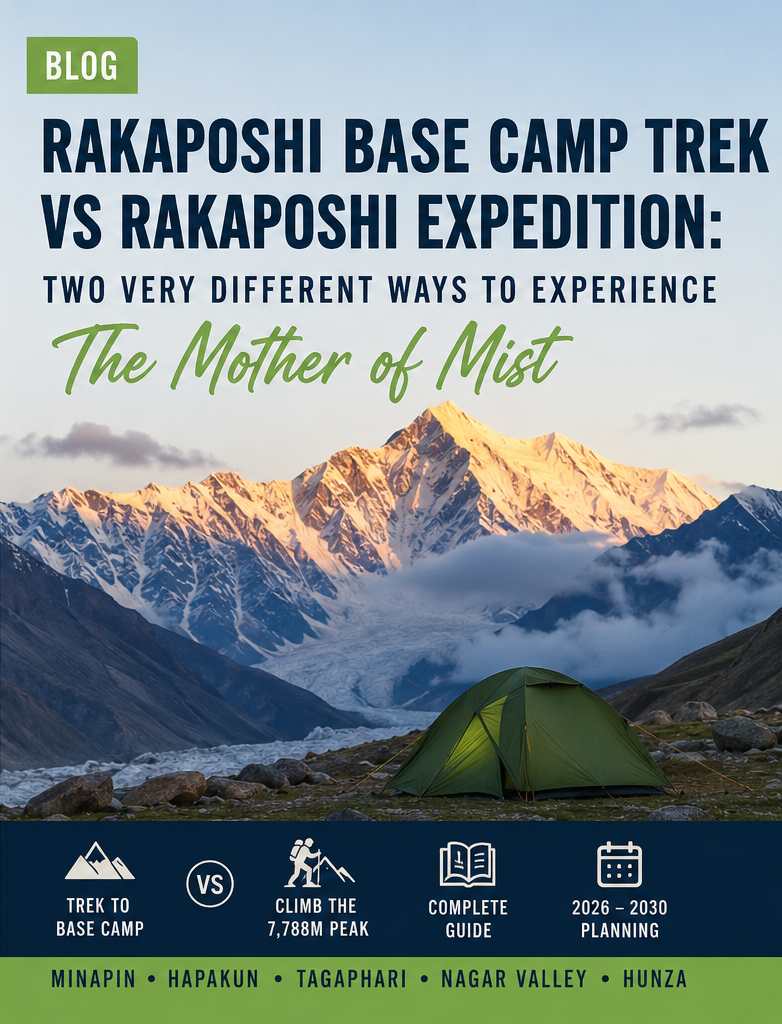
Rakaposhi Base Camp Trek vs Rakaposhi Expedition: Two Very Different Ways to Experience the Mother of Mist
There are mountains you see from a viewpoint, mountains you hike beneath, and mountains that demand weeks of preparation before you can even consider attempting their summit. Rakaposhi belongs to all three worlds.
Rising to 7,788 meters (25,551 feet) above the valleys of Gilgit-Baltistan, Rakaposhi is one of the great mountains of the Karakoram. Travelers driving along the Karakoram Highway can admire its enormous snow-covered slopes from below, trekkers can walk from the villages of Nagar toward its spectacular base camp landscape, while experienced mountaineers can approach it as a serious high-altitude climbing objective.
This creates an important question for anyone searching online for a Rakaposhi trek or Rakaposhi expedition:
Do you want to see Rakaposhi, trek to its base camp, or actually attempt to climb the mountain?
These are completely different adventures.
This guide by Adventure Touristik explains the differences and helps you choose the right way to experience Rakaposhi during a trip to Pakistan between 2026 and 2030.
Why Is Rakaposhi So Special?
Rakaposhi is located in the Karakoram mountain system of Gilgit-Baltistan, rising dramatically above Nagar and the neighboring Hunza region.
Its name is commonly interpreted as “snow-covered”, while the mountain is also romantically known as the “Mother of Mist” or “Mother of Clouds.”
What makes Rakaposhi visually extraordinary is not simply its summit elevation.
The mountain rises with tremendous vertical relief above inhabited valleys. From parts of the Karakoram Highway and Nagar, travelers can look from cultivated villages, orchards and river valleys toward an immense wall of rock, ice and snow.
This contrast makes a journey toward Rakaposhi particularly memorable.
Within a relatively short geographical distance, the landscape changes from villages and agricultural terraces to forests, summer pastures, glaciers and the high alpine environment of the Karakoram.
Three Ways to Experience Rakaposhi
One of the biggest misconceptions online is that a Rakaposhi tour, Rakaposhi Base Camp Trek, and Rakaposhi Expedition are interchangeable terms.
They are not.
1. See Rakaposhi from the Karakoram Highway
The easiest option is sightseeing.
Travelers moving between Gilgit, Nagar and Hunza can enjoy impressive views of Rakaposhi without undertaking a multi-day trek.
This is suitable for families, cultural tourists, photographers and travelers with limited time.
2. Trek to Rakaposhi Base Camp
This is the adventure most ordinary trekkers are searching for.
The journey generally begins around Minapin in Nagar Valley and leads through increasingly wild mountain landscapes toward Hapakun and the high meadows around Tagaphari, commonly associated with the Rakaposhi Base Camp trekking area.
No attempt is made to climb the 7,788-meter summit.
3. Join a Rakaposhi Expedition
This means attempting a serious high-altitude mountaineering objective.
An expedition involves permits, extensive logistics, acclimatization rotations, technical climbing, higher camps, specialized equipment and potentially several weeks on the mountain.
It is intended for experienced mountaineers—not ordinary tourists.
Where Does the Rakaposhi Base Camp Trek Begin?
The trekking journey is closely associated with Minapin, a village in Nagar District.
Nagar lies across the broader valley system from Hunza and is easily incorporated into a northern Pakistan itinerary.
This location gives the Rakaposhi trek a major advantage.
Unlike some Karakoram expeditions that require several days simply to reach the beginning of the trekking route, travelers can reach Minapin relatively conveniently from Gilgit or Hunza.
From the village environment, however, the landscape changes quickly.
The trail climbs toward higher pastures, forests and glacier-dominated scenery beneath the great mountains.
Minapin to Hapakun: Leaving the Valley Behind
The walk from Minapin toward Hapakun introduces trekkers to the physical character of the route.
The climb can feel demanding, particularly for travelers arriving directly from lower elevations.
Rather than treating the trek as a race, it is better to walk steadily and enjoy the transition in scenery.
As Minapin falls farther below, cultivated landscapes gradually give way to a quieter mountain environment.
Hapakun provides an attractive stopping point surrounded by impressive scenery.
For many trekkers, spending a night here is part of what makes the journey worthwhile.
The stars, mountain silence and early-morning light provide an experience completely different from simply visiting Rakaposhi View Point by road.
Tagaphari: The Landscape Most Trekkers Come to See
Continue upward and the landscape opens dramatically around Tagaphari.
This is the area commonly referred to by travelers and trekking operators as Rakaposhi Base Camp.
Instead of expecting a commercial Everest-style base camp filled with permanent expedition infrastructure, imagine a broad high-mountain environment where meadow, moraine, glacier and enormous peaks come together.
Weather permitting, the scenery can include extraordinary perspectives toward Rakaposhi, Diran Peak and the Minapin Glacier system.
The contrast is striking.
Green alpine ground may occupy the foreground while glaciers and heavily snow-covered mountains dominate the horizon.
This is one reason the trek is so rewarding for photographers.
Is Rakaposhi Base Camp Trek Suitable for Beginners?
This requires a more nuanced answer than simply calling the trek “easy.”
The trek is relatively accessible compared with long expeditions such as K2 Base Camp, but that does not mean everyone will find it easy.
You should expect:
-
Sustained uphill trekking
-
Considerable elevation gain
-
Rocky or uneven terrain
-
Changing mountain weather
-
Camping or basic mountain accommodation
-
Several hours of walking
-
Limited facilities once away from villages
A physically active beginner who prepares properly and travels with suitable local support may find the trek achievable.
Someone who rarely walks, has significant mobility limitations or arrives without preparation may find the ascent considerably harder.
Regular hiking, stair climbing and cardiovascular training before traveling to Pakistan can make the experience much more enjoyable.
How Many Days Do You Need for Rakaposhi Base Camp?
You will find very different answers online.
Some travelers complete the core trekking route in only a few days.
That does not necessarily mean you should build your entire holiday around the shortest possible itinerary.
A more relaxed journey can include:
Day 1: Travel toward Minapin and prepare for the trek.
Day 2: Trek toward Hapakun.
Day 3: Continue toward Tagaphari/Rakaposhi Base Camp.
Day 4: Explore the base camp landscape and enjoy photography or short walks according to conditions.
Day 5: Begin descending.
The trek can then be incorporated into a 7-day or longer Nagar and Hunza itinerary.
This gives travelers time to enjoy the mountains rather than spending every day rushing from one destination to another.
Rakaposhi Base Camp or Rush Lake: Which Trek Should You Choose?
This is a useful comparison for travelers planning a trekking holiday around Hunza and Nagar.
Both adventures begin in the broader Nagar region, but they offer very different experiences.
The Rakaposhi Base Camp Trek is an excellent choice if your priority is getting close to an enormous 7,000-meter Karakoram mountain without committing to a very long expedition-style trek.
The Rush Lake Trek, by comparison, takes travelers into a higher-altitude trekking environment involving glacier terrain and the famous alpine landscape around Rush Lake.
Choose Rakaposhi if you want:
-
A shorter mountain adventure
-
Close views of Rakaposhi
-
Alpine meadows
-
Minapin and Nagar culture
-
An easier combination with Hunza sightseeing
Consider Rush Lake if you want:
-
A more demanding high-altitude trekking experience
-
Glacier crossings with professional guidance
-
A high alpine lake destination
-
A longer wilderness experience
Adventure Touristik can also build either trek into a customized northern Pakistan itinerary.
Can You Combine Rakaposhi Base Camp with Hunza?
Absolutely—and this is one of the best ways to design the journey.
After spending several days trekking in Nagar, cross into the neighboring Hunza region and experience a completely different side of Gilgit-Baltistan.
A combined itinerary might include:
-
Karimabad
-
Baltit Fort
-
Altit Fort
-
Ganish
-
Duikar
-
Attabad Lake
-
Gulmit
-
Hussaini Suspension Bridge
-
Passu
-
Borith Lake
-
Upper Hunza/Gojal
If road and seasonal conditions permit, the journey can continue toward Khunjerab Pass near the Pakistan-China border.
This combination works particularly well for international travelers who want both trekking and cultural exploration rather than spending their entire holiday on a single trail.
Now, What Is a Rakaposhi Expedition?
This is where terminology becomes extremely important.
Searching for “Rakaposhi trek” may produce pages about both base camp trekking and climbing the actual mountain.
A Rakaposhi Expedition generally refers to an organized attempt on the 7,788-meter peak itself.
That changes everything.
A summit expedition can involve approximately five to six weeks or more, depending on the climbing strategy, weather, acclimatization, route conditions and logistical plan.
Participants may need to establish and use multiple camps above base camp.
They must operate in an environment where altitude, cold, avalanches, crevasses, ice and rapidly changing weather can have serious consequences.
This is not an extension of the tourist trek.
It is mountaineering.
Who Should Consider Climbing Rakaposhi?
Rakaposhi should only be considered by climbers whose previous experience appropriately prepares them for a serious 7,000-meter Karakoram expedition.
Relevant experience may include:
-
High-altitude mountaineering
-
Previous 6,000m or 7,000m ascents
-
Glacier travel
-
Crevasse rescue
-
Rope techniques
-
Crampon use
-
Ice-axe skills
-
Snow and ice climbing
-
Expedition camping
-
Acclimatization management
-
Self-rescue
-
Operating independently in remote mountain environments
Simply being physically fit is not enough.
Someone capable of running a marathon may have excellent cardiovascular fitness but still lack the technical skills and high-altitude experience required for a serious Karakoram expedition.
Expedition applicants should expect to provide information about previous climbs and mountaineering experience.
The Story of Rakaposhi’s First Ascent
Rakaposhi has an important place in the history of Karakoram mountaineering.
The mountain’s first successful ascent was achieved in 1958, with British climbers Mike Banks and Tom Patey reaching the summit during a British-Pakistani expedition.
Their achievement came during an era when Himalayan and Karakoram mountaineering involved considerably different equipment, communications and logistical capabilities from those available today.
Modern technology has improved weather forecasting, equipment and communications, but Rakaposhi remains a serious mountain.
Technology does not remove altitude, objective hazards or unpredictable conditions.
How Long Does a Rakaposhi Expedition Take?
A realistic expedition schedule may require around 35–45 days, although exact duration depends on the expedition plan.
The journey typically involves several phases.
First comes arrival in Pakistan, administrative preparation and transportation north.
The team then moves toward Nagar and approaches base camp.
Once established, climbers begin the most unpredictable part of the expedition: acclimatization and climbing rotations.
They may spend weeks:
-
Assessing conditions
-
Establishing camps
-
Carrying equipment
-
Acclimatizing
-
Resting
-
Monitoring weather
-
Preparing for a possible summit window
A summit attempt only takes place if conditions, team readiness and safety considerations allow.
No responsible operator can promise a summit.
Base Camp Service or Full Expedition Support?
International mountaineers organize expeditions in different ways.
Some highly experienced teams want to climb independently above base camp but need local logistical assistance.
A base camp service package may therefore include arrangements such as:
-
Permit assistance
-
Ground transportation
-
Porter logistics
-
Base camp tents
-
Kitchen and dining facilities
-
Cook and support staff
-
Base camp meals
-
Cargo coordination
-
Local administrative support
-
Communication arrangements
Other teams require more extensive support.
A customized expedition may involve additional high-altitude personnel, equipment movement and other specialized arrangements.
Because every expedition is different, climbers should request a detailed written quotation rather than selecting a package solely by looking at the cheapest advertised online price.
How Much Does a Rakaposhi Expedition Cost?
You may find online prices starting at around USD 3,990 per climber, particularly for larger teams using selected base camp service arrangements.
However, this number needs context.
Expedition costs vary considerably according to:
-
Number of climbers
-
Service level
-
Permit and royalty charges
-
Expedition duration
-
Number of staff
-
Porter requirements
-
Domestic transportation
-
Hotels
-
Food and fuel
-
High-altitude support
-
Communication systems
-
Equipment requirements
-
Government regulations
A solo climber requiring extensive logistical support will generally pay considerably more per person than a large team sharing fixed expedition costs.
For a 2026, 2027, 2028, 2029 or 2030 Rakaposhi Expedition, request a current quotation rather than relying on prices published several years earlier.
A Warning About Old Rakaposhi Permit and Royalty Information Online
This deserves special attention.
Travelers researching mountaineering in Pakistan frequently encounter old websites containing climbing royalties, deposit schedules and regulations from previous years.
Some even display payment schedules dating back many years.
Do not automatically assume these figures remain valid for your expedition.
Government policies, royalties, environmental requirements and administrative procedures can change.
For a future Rakaposhi climb, verify current requirements before paying deposits or purchasing non-refundable international flights.
Adventure Touristik can coordinate current expedition requirements as part of the planning process.
When Is the Best Time to Trek to Rakaposhi Base Camp?
For ordinary trekking, the broad season generally extends from late spring into autumn, depending on snow and trail conditions.
May and June
The landscape can be beautifully green, while Rakaposhi remains heavily snow-covered.
July and August
These are popular summer travel months across Gilgit-Baltistan.
Valley temperatures are warmer, although mountain weather can still change rapidly.
September
September can be particularly attractive for trekkers looking for generally cooler temperatures and excellent mountain photography.
October
Autumn colors can transform Nagar and Hunza.
Higher elevations become colder, however, and trekkers should check current conditions before departure.
The ideal timing for a summit expedition is a separate question and should be determined according to the climbing route, expedition strategy, permits and expected mountain conditions.
Rakaposhi or K2 Base Camp: Which Trek Is Better?
These two adventures should not really be treated as competitors.
They serve different travelers.
Rakaposhi Base Camp is suitable for people seeking a relatively compact Karakoram trekking experience that can easily be combined with Nagar and Hunza.
K2 Base Camp is a much longer wilderness journey through the Baltoro region, requiring considerably more time and logistical commitment.
If you have only one or two weeks in northern Pakistan and want to combine trekking with sightseeing, Rakaposhi may fit your itinerary better.
If trekking itself is the central purpose of your trip and you have enough time for a major Karakoram journey, K2 Base Camp offers an entirely different scale of adventure.
Is Rakaposhi Base Camp Actually in Hunza?
This is another common source of confusion.
You will often see online phrases such as “Rakaposhi Base Camp Hunza Trek.”
Geographically, the popular trekking approach through Minapin is in Nagar, not Hunza.
Why the confusion?
Hunza is internationally much better known as a tourism destination, and travelers frequently visit Nagar and Hunza during the same trip.
The two areas are neighboring destinations and can easily be combined.
For accurate trip planning, however, remember:
Minapin → Hapakun → Tagaphari/Rakaposhi Base Camp = Nagar Valley trekking route.
Hunza makes an excellent extension before or after the trek.
Responsible Trekking Beneath Rakaposhi
The increasing popularity of mountain tourism creates both opportunities and challenges for local communities.
Trekkers can help protect the region through simple decisions.
Carry reusable water bottles where practical.
Avoid leaving plastic or food packaging on trails.
Do not disturb livestock or agricultural land.
Respect local customs when photographing residents.
Use established camping areas where appropriate.
Support local guides, porters, accommodation providers and businesses.
Mountain landscapes may look enormous and untouched, but high-altitude ecosystems can be surprisingly fragile.
Responsible tourism helps ensure that places such as Minapin, Hapakun and Tagaphari remain beautiful for future visitors.
What Should You Pack for Rakaposhi Base Camp?
Packing should reflect the season and current conditions rather than relying on a generic list.
Typical essentials include:
-
Broken-in trekking boots
-
Comfortable trekking clothing
-
Warm insulating layers
-
Waterproof/windproof outer shell
-
Sun hat
-
Warm hat
-
Gloves
-
Sunglasses with strong UV protection
-
Sunscreen
-
Trekking poles
-
Headlamp
-
Personal medication
-
Reusable water bottle
-
Small personal first-aid supplies
-
Power bank
-
Appropriate sleeping system if not supplied
Avoid buying brand-new trekking boots immediately before flying to Pakistan.
Wear them during training first.
Blisters can turn an otherwise spectacular trek into an unnecessarily uncomfortable experience.
Frequently Asked Questions About Rakaposhi
Is Rakaposhi Base Camp worth visiting?
For travelers who enjoy mountain landscapes and trekking, it can be one of the most rewarding short adventures in the Nagar-Hunza region. The combination of alpine meadows, glacier scenery and close views of huge Karakoram peaks makes it particularly attractive.
How high is Rakaposhi?
Rakaposhi reaches approximately 7,788 meters or 25,551 feet.
Where does the trek start?
The popular base camp trekking route begins around Minapin Village in Nagar, Gilgit-Baltistan.
Can a beginner trek to Rakaposhi Base Camp?
A fit and properly prepared beginner may undertake the standard trekking route with suitable guidance. Do not confuse this with climbing Rakaposhi itself.
Can beginners climb Rakaposhi Peak?
No. A Rakaposhi summit expedition is a serious high-altitude mountaineering undertaking requiring appropriate technical skills and previous experience.
Can I combine Rakaposhi with Hunza?
Yes. This is one of the best combinations for a northern Pakistan itinerary. You can trek in Nagar and then explore Karimabad, Altit, Attabad Lake, Gulmit and Passu.
How long should I allow for the base camp experience?
Although the core trek can be relatively short, allowing around 5–7 days including transportation and a relaxed itinerary creates a better overall experience.
How long does a summit expedition take?
Expedition schedules commonly require several weeks, often around 35–45 days, depending on strategy and conditions.
Is reaching Rakaposhi’s summit guaranteed?
Absolutely not. Weather, snow, route conditions, altitude, health and many other factors determine whether a summit attempt is possible.
Trek to the Base Camp or Climb the Mountain?
Rakaposhi offers something unusual: two adventures of dramatically different scales beneath the same mountain.
For most travelers, the answer is the Rakaposhi Base Camp Trek.
Walking from the villages of Nagar into the high meadows beneath one of the Karakoram’s great mountains provides adventure without requiring a month-long expedition.
You can trek, camp beneath enormous peaks, photograph glaciers and then continue into Hunza for cultural exploration.
For experienced mountaineers, Rakaposhi represents something entirely different.
At 7,788 meters, it is a serious expedition objective requiring technical competence, extensive preparation, permits, logistics, patience and respect for one of the world’s great mountain environments.
Whichever experience brings you to Nagar, the mountain remains the same—an immense wall of rock, snow and ice rising dramatically above the valleys of Gilgit-Baltistan.
Plan Your Rakaposhi Adventure for 2026–2030
Adventure Touristik organizes customized trekking, cultural tours and mountaineering logistics in northern Pakistan.
You can request a customized:
Rakaposhi Base Camp Trek, Rakaposhi and Hunza Tour, or Rakaposhi 7,788m Expedition for 2026–2030.
WhatsApp / Mobile: +92 355 5808382