Batura Glacier Trek in Pakistan: A Journey Through the Wild Heart of Hunza
Pakistan’s Karakoram Mountains contain some of the greatest concentrations of glaciers and high peaks anywhere outside the polar regions. Yet when travelers begin researching trekking in Pakistan, famous names such as K2, Baltoro and Concordia often dominate the results.
There is another extraordinary glacier landscape that deserves just as much attention: Batura Glacier in Upper Hunza.
Located near Passu in the Gojal region of Gilgit-Baltistan, Batura offers something remarkably different from many of Pakistan’s better-known high-altitude adventures. Here, enormous mountains and glaciers meet green summer pastures, traditional Wakhi settlements and the dramatic landscapes of Upper Hunza.
For travelers planning a Pakistan trekking adventure in 2026 or 2027, the Batura Glacier region offers an opportunity to discover a quieter and culturally fascinating side of the Karakoram.
And there is one question we frequently hear from travelers:
Are you confused between Batura Glacier and Baltoro Glacier?
You are certainly not alone.
Despite their similar-sounding names, Batura and Baltoro are two completely different glaciers, located in different parts of Gilgit-Baltistan and offering very different trekking experiences.
This guide explains the difference—and everything you should know before considering a journey to Batura.
Where Is Batura Glacier?
Batura Glacier is located in Upper Hunza, also known as Gojal, in Gilgit-Baltistan, northern Pakistan.
The glacier lies in the Batura Muztagh, part of the greater Karakoram mountain system.
For most travelers, the gateway to the region is Passu, one of the most recognizable mountain villages in Pakistan.
Passu is situated along the legendary Karakoram Highway and is famous for its spectacular mountain scenery, particularly the sharp, cathedral-like formations commonly known as the Passu Cones.
Traveling north through Hunza toward Passu already feels like an adventure.
The road passes through some of Pakistan’s most dramatic mountain landscapes, including the turquoise waters of Attabad Lake and the rugged terrain of Upper Hunza.
But beyond the Karakoram Highway lies an entirely different world.
That is where the Batura adventure begins.
Are You Confused with Batura Glacier and Baltoro Glacier?
This is an important question because international travelers researching glaciers and trekking routes in Pakistan sometimes confuse Batura Glacier with Baltoro Glacier.
The names may sound somewhat similar.
The destinations are not.
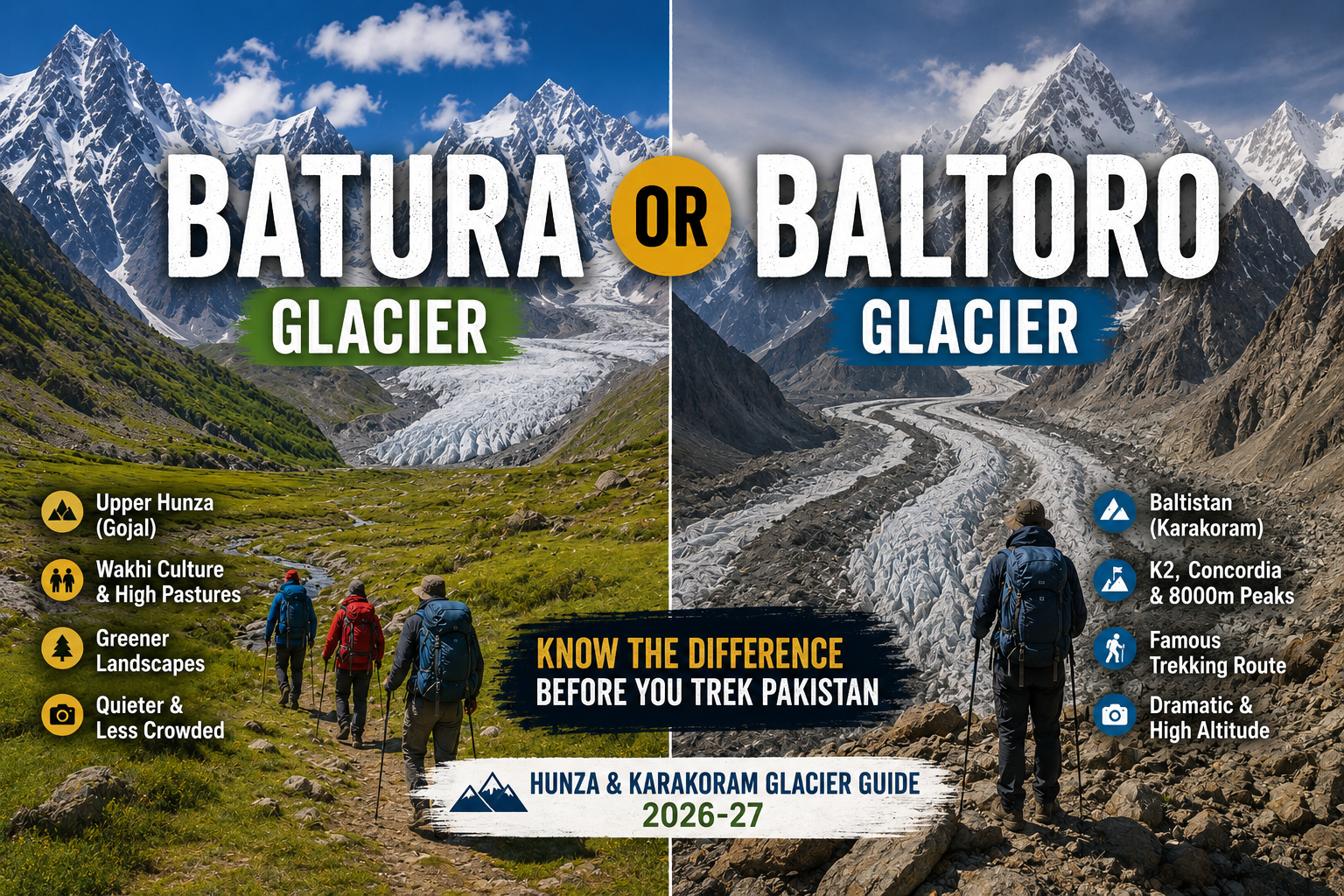
Batura Glacier vs Baltoro Glacier
Batura Glacier is located in the Upper Hunza/Gojal region, near Passu.
Baltoro Glacier is located in the Baltistan region and forms part of the legendary trekking route toward Concordia and K2 Base Camp.
Both are in Gilgit-Baltistan and both belong to the greater Karakoram mountain system, but they offer distinctly different experiences.
Batura Glacier
Think of Batura as a journey combining:
glacier + alpine pastures + Wakhi culture + Upper Hunza + quieter wilderness.
The Batura region is particularly fascinating because trekkers encounter dramatic contrasts between ice, mountains and surprisingly green seasonal pastures.
The trek is closely connected with the cultural landscape of Gojal and the Wakhi communities of Upper Hunza.
Baltoro Glacier
Think of Baltoro as:
K2 + Concordia + giant 8,000-meter mountains + legendary expedition history.
The Baltoro route is internationally famous because it provides access toward Concordia and K2 Base Camp.
Its mountain skyline includes some of the greatest peaks on Earth.
Which One Should You Choose?
Choose Batura Glacier if you are especially interested in:
-
Upper Hunza
-
Wakhi culture
-
Remote alpine pastures
-
A quieter Karakoram trekking experience
-
Glacier landscapes mixed with greener mountain environments
-
Combining trekking with a wider Hunza Valley journey
Choose Baltoro Glacier if your primary dream is:
-
Seeing K2
-
Reaching Concordia
-
Visiting K2 Base Camp
-
Experiencing one of the world’s most famous high-altitude trekking corridors
-
Seeing legendary Karakoram peaks associated with mountaineering history
Neither trek is simply a substitute for the other.
They represent two very different faces of the Karakoram.
For serious mountain travelers, experiencing both on separate journeys would provide an extraordinary understanding of northern Pakistan.
Why Is Batura Glacier Famous?
Batura is widely recognized as one of the great glaciers of the Karakoram.
It is commonly described as stretching approximately 57 kilometers, although glacier measurements and rankings can vary depending on methodology and geographic definitions.
Rather than focusing only on rankings such as “longest” or “seventh longest,” what truly makes Batura remarkable is its scale and environment.
Imagine standing in a remote mountain valley where an immense glacier extends beneath some of the highest mountains in the region.
Now imagine that same landscape bordered in places by summer pastures where livestock graze beneath snow-covered peaks.
That contrast is part of Batura’s character.
It does not feel like a landscape composed entirely of ice and rock.
There is life here.
There is culture.
There is a centuries-old relationship between mountain communities and their environment.
That combination makes trekking around Batura particularly memorable.
Batura Is More Than a Glacier Trek
Many people discover Batura by searching for phrases such as “Batura Glacier Trek Pakistan” or “best treks in Hunza.”
But describing the journey simply as a glacier trek does not tell the whole story.
A Batura journey can be understood through three interconnected experiences.
1. The Glacier
The enormous glacier system creates the geographical foundation of the adventure.
Trekkers move through landscapes shaped by ice, moraine, streams and centuries of geological processes.
The scale can be difficult to understand from photographs.
Only when humans appear in the landscape does the enormous size of the mountains and glacier become obvious.
2. The Mountains
Batura lies beneath the spectacular mountains of the Batura Muztagh.
The wider region contains towering Karakoram summits, including Batura Sar and Shishpare, together with numerous other dramatic peaks and ridges.
Weather constantly transforms the scenery.
A mountain hidden behind clouds in the morning may suddenly appear in brilliant sunlight hours later.
For photographers, these changing conditions can create extraordinary opportunities.
3. The People
Perhaps the most meaningful dimension of the journey is cultural.
Upper Hunza is home to communities with deep historical relationships with these mountains.
Traditional seasonal movement into high pastures has shaped the cultural landscape for generations.
Visitors therefore encounter not simply an empty wilderness but a mountain environment connected to human history and tradition.
The Wakhi Cultural Landscape of Upper Hunza
One of the major differences between trekking in Batura and many other glacier regions is the opportunity to experience the cultural geography of Gojal.
The Wakhi people have lived across high mountain regions spanning parts of present-day Pakistan and neighboring areas of Central and South Asia.
In Upper Hunza, their communities have developed traditions adapted to an extraordinary environment of high mountains, short growing seasons and remote valleys.
During warmer months, high-altitude pastures have traditionally been used for grazing livestock.
These seasonal landscapes are part of what makes the Batura region visually distinctive.
A trek through this environment can reveal how closely mountain culture and geography are connected.
Travelers should approach these communities respectfully.
Local settlements and grazing areas are not tourist props. They are living cultural landscapes.
Ask before photographing people.
Respect livestock and agricultural areas.
Avoid disturbing local routines.
Follow your guide’s advice.
Small acts of respect can make tourism a much more positive experience for both visitors and host communities.
What Does the Batura Glacier Trek Landscape Look Like?
Expect variety.
One day may be dominated by rugged moraine and enormous mountain walls.
Another may bring greener landscapes, streams and grazing areas.
Depending on the route, season and conditions, trekkers may encounter:
-
Glacier and moraine landscapes
-
Alpine meadows
-
Mountain streams
-
Wildflowers
-
Traditional summer grazing areas
-
Yaks, sheep or goats
-
Huge Karakoram peaks
-
Remote campsites
-
Birch and juniper vegetation in suitable areas
-
Dramatic sunrise and sunset photography
This diversity is one reason Batura stands apart from the stereotypical image of glacier trekking.
It is not simply endless white ice.
The landscape constantly changes.
Where Does a Batura Glacier Journey Start?
International trekking journeys generally begin in Islamabad, Pakistan’s capital.
From Islamabad, travelers usually continue north toward Gilgit-Baltistan.
Depending on weather, itinerary and transportation arrangements, this may involve a domestic flight to Gilgit or an overland journey.
From Gilgit, the journey continues along the Karakoram Highway toward Hunza and Upper Hunza.
Eventually, travelers reach the Passu area.
Passu itself is worth experiencing before or after trekking.
The village sits beneath spectacular mountains and is surrounded by some of Pakistan’s most recognizable landscapes.
The famous Passu Cones dominate the skyline, while the wider region includes glaciers, suspension bridges, traditional villages and access to northern sections of the Karakoram Highway.
The Karakoram Highway Is Part of the Adventure
Getting to Batura is not merely transportation.
It is part of the experience.
The Karakoram Highway, connecting Pakistan’s northern regions toward the Chinese border, is considered one of the world’s great mountain roads.
Traveling through Hunza provides constantly changing scenery.
Deep valleys open beneath enormous mountains.
Rivers cut through barren rock.
Villages appear as green islands surrounded by otherwise rugged landscapes.
Depending on the itinerary, travelers may pass or visit famous Upper Hunza attractions such as:
-
Attabad Lake
-
Gulmit
-
Passu
-
Hussaini
-
Borith Lake
-
Passu Cones
-
Khunjerab region
Combining these destinations with trekking can create a broader experience of Hunza rather than treating the journey only as a physical expedition.
How Difficult Is the Batura Glacier Trek?
The answer depends heavily on your experience and fitness.
Batura should not be treated as an ordinary sightseeing holiday.
It is a genuine wilderness trek.
Participants may need to walk for several consecutive days over uneven mountain terrain.
Conditions can include moraine, rocky trails, glacier-related terrain, streams, changing weather and remote campsites.
Good physical preparation is therefore important.
You do not necessarily need to be an elite athlete.
But you should be comfortable walking for extended periods and capable of maintaining steady physical activity over multiple days.
Before traveling, regular hiking, cardiovascular training and leg-strengthening exercises can help prepare your body.
Walking uphill while carrying a light daypack is particularly useful training.
Do You Need Technical Mountaineering Experience?
A standard Batura trekking itinerary is generally approached as a trek rather than a technical climbing expedition.
However, conditions in glacier environments can change.
Routes that were straightforward in one season may be affected by glacier movement, streams, weather or erosion in another.
This is why local knowledge matters.
Travelers should follow experienced guides familiar with current conditions rather than relying solely on old maps, blogs or GPS tracks downloaded from the internet.
The Karakoram is dynamic.
The mountains change.
Glaciers move.
Trails change.
Professional local guidance can therefore be an important part of safe and responsible trekking.
What Is the Best Time to Visit Batura Glacier?
The main trekking window generally falls during the warmer summer months.
For many travelers, June through September represents the most practical period for trekking in the Batura region, although exact conditions vary from year to year.
June can offer fresh mountain scenery and longer daylight.
July and August fall within the main summer trekking period.
September can sometimes offer clearer autumn conditions and changing colors, though temperatures may become colder.
There is no single month that guarantees perfect weather.
Mountain weather is unpredictable.
Trekkers should always prepare for changing temperatures, rain, wind and cold nights.
How Many Days Do You Need?
The number of days depends on how the itinerary is designed.
A complete international trekking holiday may require around two weeks or more when you include:
-
Arrival in Islamabad
-
Travel to Gilgit-Baltistan
-
Journey to Upper Hunza
-
Trekking days
-
Rest or contingency days
-
Return transportation
-
Departure from Pakistan
Adventure Touristik’s dedicated Batura Glacier Trek 2026–27 program is designed as a 16-day journey, allowing time not only for trekking but also for transportation and contingency planning.
Contingency days are important in northern Pakistan.
Domestic mountain flights can be affected by weather.
Road conditions can also change.
A responsible itinerary should therefore avoid making international departure connections too tight.
Places You May Encounter Along the Batura Trek
Depending on the final route and current conditions, names commonly associated with Batura trekking itineraries include:
Yunzben
One of the early trekking areas as travelers move deeper into the Batura landscape.
The surroundings introduce trekkers to the scale of the glacier environment and the transition from settled valleys toward wilderness.
Ujhoupirt
Another location encountered as the journey continues deeper into the region.
The changing combination of vegetation, glacier and mountain scenery becomes increasingly impressive.
Yashpirt
Yashpirt is associated with the beautiful high-pasture landscapes that make Batura distinctive.
For many visitors, these greener landscapes surrounded by huge mountains become some of the most memorable scenes of the journey.
Gutshism
Farther into the trekking route, the sense of isolation becomes stronger.
This is the kind of place where the scale of the Karakoram becomes difficult to describe.
Mountains dominate every direction.
Human settlements feel very far away.
Is Batura Glacier Trek Crowded?
Compared with internationally famous trekking destinations in Nepal and some better-known Karakoram routes, Batura can feel remarkably quiet.
That is part of its attraction.
Travelers searching for nightlife, luxury resorts or busy trekking villages will not find that experience here.
Instead, the rewards are:
Silence.
Space.
Mountains.
Glaciers.
Pastures.
And the feeling of traveling through a landscape that remains far removed from mass tourism.
For many adventure travelers, that is exactly the point.
Batura Glacier Trek or K2 Base Camp Trek?
This is another common comparison.
Both are Karakoram adventures, but the experiences are significantly different.
The K2 Base Camp Trek is built around one of mountaineering’s greatest destinations.
Its legendary highlights include Baltoro Glacier, Concordia and views of some of the world’s highest mountains.
Batura offers a different atmosphere.
Its appeal lies more strongly in the combination of glacier wilderness, Upper Hunza landscapes, high pastures and cultural connections with Gojal.
If seeing K2 is your lifelong dream, choose the K2 Base Camp route.
If you want a quieter trek with a strong combination of natural and cultural landscapes, consider Batura.
If you have enough time to visit Pakistan more than once?
Do both.
They tell completely different stories about the Karakoram.
Batura Glacier Trek or Patundas Trek?
These two adventures are geographically closer and can appeal to travelers interested in Upper Hunza.
Patundas is famous for its spectacular high viewpoint and panoramic mountain scenery.
Batura provides a longer and deeper journey into a major glacier and pasture landscape.
Travelers with limited time may consider a shorter Hunza trek.
Those wanting a more immersive multi-day wilderness experience may prefer Batura.
The right choice depends on available time, fitness and the type of experience you want.
What Should You Pack?
Packing properly can significantly improve your trekking experience.
Essential equipment generally includes:
-
Broken-in trekking boots
-
Comfortable trekking clothing
-
Warm insulated layers
-
Waterproof jacket
-
Wind protection
-
Sun hat
-
Warm hat
-
Gloves
-
Sunglasses with strong UV protection
-
Sunscreen
-
Trekking poles
-
Headlamp
-
Personal first-aid supplies
-
Reusable water bottle
-
Suitable sleeping bag
-
Daypack
-
Personal hygiene items
-
Power bank
-
Camera or smartphone
-
Spare batteries where needed
Avoid buying brand-new trekking boots immediately before departure.
Wear them during training walks first.
Blisters can turn an extraordinary trekking experience into a painful one very quickly.
Responsible Trekking in Batura
Glacier environments are fragile.
Tourism should not add unnecessary pressure to them.
Visitors can help by following several simple principles.
Carry reusable bottles where practical.
Avoid single-use plastics.
Never leave batteries, wipes or plastic packaging behind.
Do not contaminate streams.
Respect wildlife.
Follow established campsites and local guidance.
Respect Wakhi communities and their seasonal grazing areas.
Support local guides, porters, drivers, accommodation providers and community businesses whenever possible.
Responsible tourism should leave economic benefits in the communities that make these journeys possible.
Why Travel with a Local Pakistan Trekking Company?
Organizing an independent trip into a remote Karakoram region can involve much more than booking hotels.
There may be transportation logistics, guides, porters, camping equipment, food supplies, route planning and contingency arrangements.
Working with an experienced local company can simplify these challenges.
Adventure Touristik is based around a deep connection with northern Pakistan and focuses on helping international and domestic travelers experience Pakistan through trekking, adventure and cultural journeys.
Local knowledge becomes especially valuable when plans change.
A cancelled flight.
A blocked road.
Unexpected weather.
A changed trail condition.
These are situations where experienced local coordination matters.
Batura Glacier Trek 2026–27
Adventure Touristik is offering trekking opportunities for travelers planning to explore Batura during the 2026 and 2027 trekking seasons.
A typical full program can include approximately 16 days covering Islamabad, travel into Gilgit-Baltistan, Upper Hunza, the Batura trekking route and return transportation.
Travelers can choose scheduled departures where available or inquire about private arrangements.
Because trekking logistics in remote mountain regions require advance preparation, international travelers should consider planning early.
For complete departure dates, current pricing, inclusions, exclusions and booking conditions, visit the dedicated Batura Glacier Trek tour page on Adventure Touristik.
Frequently Asked Questions About Batura Glacier
Are Batura Glacier and Baltoro Glacier the same?
No.
They are completely different glaciers.
Batura Glacier is located in Upper Hunza/Gojal near Passu, while Baltoro Glacier is in Baltistan and forms part of the famous trekking route toward Concordia and K2 Base Camp.
This is one of the most important distinctions for travelers planning a Pakistan trekking holiday.
Is Batura Glacier in Hunza?
Yes.
Batura Glacier is located in the Upper Hunza/Gojal region of Gilgit-Baltistan, Pakistan.
Is Batura Glacier near Passu?
Yes. Passu is an important gateway for exploring the Batura region.
How long is Batura Glacier?
Batura Glacier is commonly reported to extend approximately 57 kilometers, although exact measurements can differ according to sources and measurement methods.
Is Batura Glacier the longest glacier in Pakistan?
Pakistan contains several exceptionally long non-polar glaciers, particularly in the Karakoram.
Rather than relying on changing numerical rankings, Batura is best described as one of Pakistan’s major and longest glacier systems and one of the notable long glaciers outside the polar regions.
Can foreigners trek Batura Glacier?
International travelers can visit and trek in the region subject to Pakistan’s current visa, travel and any applicable local regulatory requirements.
Always confirm current requirements before travel.
Is Batura the same trek as K2 Base Camp?
No.
K2 Base Camp is accessed through the Baltoro/Concordia region of Baltistan.
Batura Glacier Trek takes place in Upper Hunza/Gojal.
What is the nearest famous village to Batura Glacier?
Passu is one of the best-known villages associated with access to the Batura region.
Is Batura worth visiting?
For travelers interested in glaciers, remote trekking, Karakoram landscapes, photography and the culture of Upper Hunza, Batura can be one of Pakistan’s most rewarding adventure destinations.
Two Glaciers, Two Extraordinary Adventures
So, are you confused with Batura Glacier and Baltoro Glacier?
Remember one simple distinction:
Batura = Hunza.
Baltoro = K2 and Concordia.
Batura takes you into the glacier and pasture landscapes of Upper Hunza, where the natural environment is closely connected with Wakhi mountain culture.
Baltoro takes you toward the legendary heart of the Central Karakoram, where K2 and some of the world’s greatest mountains dominate the horizon.
Both are extraordinary.
But Batura has a character entirely its own.
It is quieter.
Greener in places.
Deeply connected with the cultural landscape of Upper Hunza.
And overwhelmingly beautiful.
For travelers who want to go beyond Pakistan’s most famous tourist photographs and experience the mountains slowly, on foot, Batura Glacier deserves a place on the adventure list for 2026–27 and beyond.
Plan Your Batura Glacier Adventure with Adventure Touristik
Explore the mountains of northern Pakistan with people who know the region.
Adventure Touristik offers Batura Glacier trekking tours, Hunza Valley adventures, Karakoram treks and customized Pakistan tour packages for international and domestic travelers.
Whether you want to join a scheduled Batura departure, organize a private trekking group or combine Hunza with other destinations in Gilgit-Baltistan, your journey can be customized according to your time and interests.
Discover Batura. Experience Hunza. Walk into the Karakoram.