Snow Lake Trek Pakistan: Crossing Biafo Glacier & Hispar La in the Heart of the Karakoram
Few trekking routes in the world feel as wild, isolated, and genuinely expeditionary as the Snow Lake Trek in Pakistan. Hidden deep within the Karakoram Mountains of Gilgit-Baltistan, this extraordinary journey crosses enormous glaciers, remote wilderness, high mountain passes, and landscapes where there are no permanent settlements for days at a time.
Also known as the Biafo Hispar La Trek, the route connects the mountain regions of Baltistan and Nagar-Hunza through the vast Biafo and Hispar glacier systems. At its heart lies Snow Lake, or Lukpe Lawo, an immense high-altitude glacial basin surrounded by some of the Karakoram's most dramatic peaks.
For experienced trekkers searching for something beyond ordinary hiking trails, the Snow Lake Trek Pakistan 2026–2030 offers a rare opportunity to cross one of the great wilderness routes of Asia.
With Adventure Touristik, travelers can experience this remarkable traverse as a professionally organized expedition with local guides, porters, camping logistics, transportation, accommodation, and on-ground support.
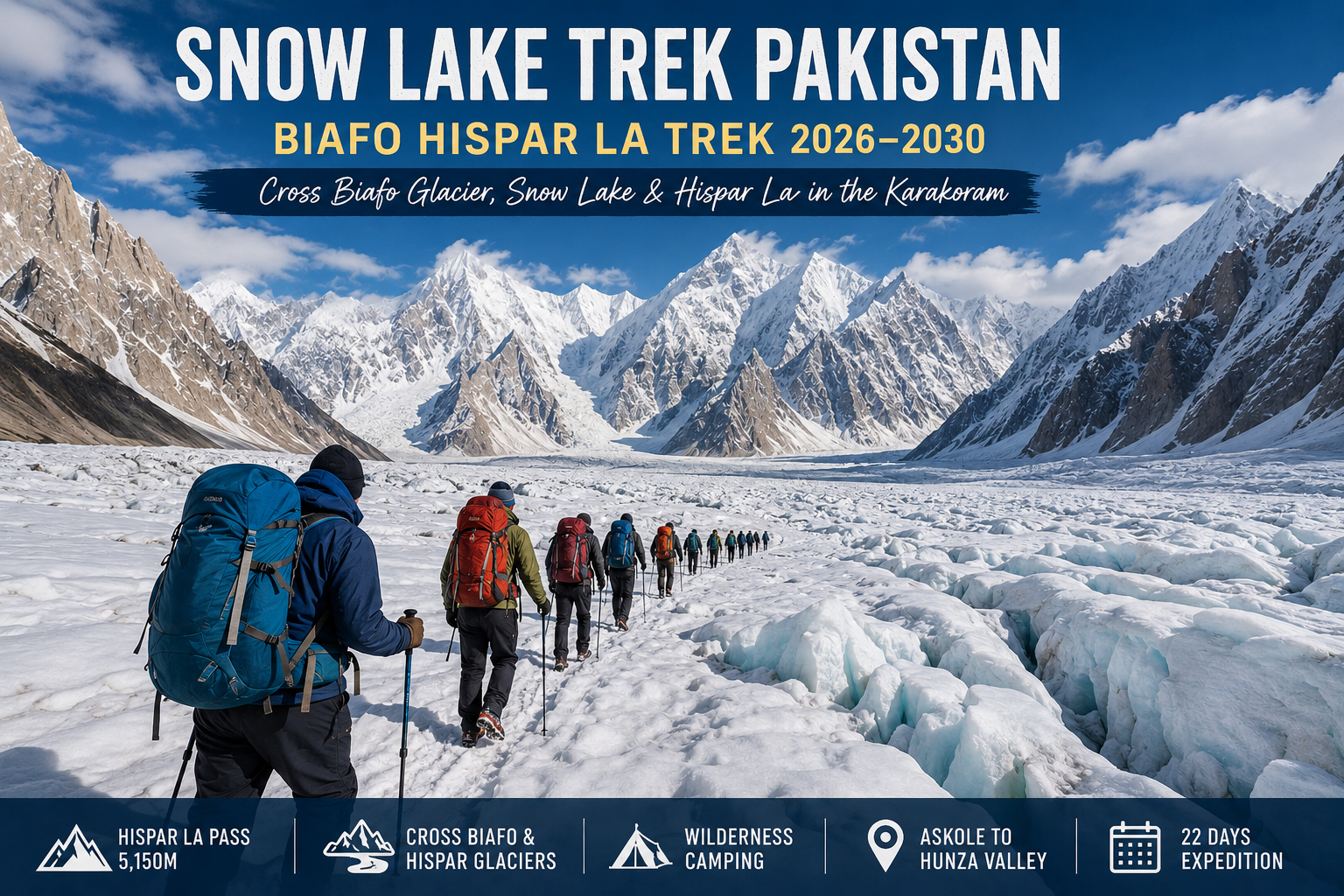
Featured Image Alt: Snow Lake Trek Pakistan across Biafo Glacier and Hispar La in the Karakoram
What Is the Snow Lake Trek?
The Snow Lake Trek is a demanding high-altitude traverse through the Karakoram Range of northern Pakistan.
Unlike a conventional trek where hikers follow established trails between villages and lodges, much of this journey takes place across glaciers, moraine, snowfields, rocky terrain, and remote campsites.
The classic route begins near Askole, one of the principal gateways into the central Karakoram.
From Askole, trekkers enter the wilderness and gradually approach the Biafo Glacier, following it toward the enormous glacial basin known as Snow Lake.
The journey then crosses Hispar La, at approximately 5,150 meters, before descending along the Hispar Glacier toward Hispar village in Nagar.
From there, civilization slowly returns: green fields, villages, roads, and eventually the beautiful Hunza region.
It is this dramatic transition—from Baltistan's rugged valleys into a seemingly endless world of ice, then back into the green settlements of Nagar and Hunza—that makes the trek so memorable.
Why Is It Called Snow Lake?
The name can be slightly misleading.
Snow Lake is not a conventional blue alpine lake surrounded by grass and mountains.
It is an enormous high-altitude glacial basin near the meeting area of major glacier systems deep in the Karakoram.
Known locally as Lukpe Lawo, the area presents trekkers with a vast landscape of snow and ice stretching toward some of Pakistan's most remote mountains.
The scale is difficult to understand from photographs alone.
After spending days walking through narrow valleys, moraine, and glacier corridors, reaching the broad Snow Lake basin creates an extraordinary sense of space.
Mountains rise in almost every direction while the trekking route disappears across an immense frozen landscape.
This is one of the defining experiences of the Snow Lake Hispar La Trek.
Biafo Glacier: Entering the Karakoram Wilderness
The Biafo Glacier forms one of the most important sections of the journey.
Trekkers normally approach it after leaving Askole and gradually move deeper into an increasingly isolated mountain environment.
Walking here is very different from hiking on a normal mountain trail.
Depending on conditions, trekkers encounter combinations of:
-
Rocky moraine and loose stones
-
Glacier ice and snow
-
Crevassed sections
-
Uneven glacier surfaces
-
Steep ascents and descents
-
Glacial streams
-
Remote campsites with no permanent facilities
Progress can therefore be slower than distance alone suggests.
A day covering what appears to be a modest number of kilometers can require many hours because every step must be carefully negotiated.
This is why the Snow Lake Trek should be viewed as an expedition-style trek rather than an ordinary hiking holiday.
The Journey from Askole to Snow Lake
Askole is one of the most famous trekking gateways in Pakistan.
It is also associated with expeditions heading toward some of the great mountains of the central Karakoram.
For the Snow Lake route, however, trekkers eventually turn toward the Biafo Glacier and begin their journey northwest.
Typical camps along this section may include locations such as:
Namla → Mango → Baintha → Marfogoro/Karphogoro → Snow Lake → Hispar La
The exact camping plan can change according to glacier conditions, weather, acclimatization needs, and decisions made by the expedition leader.
One of the most welcome locations during the ascent is Baintha.
After several demanding trekking days, an acclimatization or rest day here gives the body valuable time to adapt before continuing toward higher elevations.
The surrounding landscape also provides magnificent views toward some of the dramatic granite and ice-covered mountains of the Karakoram.
Crossing Snow Lake and Hispar La
The crossing of Snow Lake and Hispar La is the geographical and emotional centerpiece of the expedition.
As the team climbs higher, the landscape becomes increasingly dominated by snow and ice.
Vegetation disappears.
The camps become more isolated.
Weather becomes more influential.
At these elevations, seemingly simple activities—walking, packing equipment, setting up camp—require greater effort.
Hispar La rises to approximately 5,150 meters, although published elevations vary slightly depending on mapping sources.
The approach requires careful glacier travel.
Crevasses are a serious consideration, and conditions can change from season to season.
For this reason, the crossing should be undertaken with experienced local mountain professionals who understand current glacier conditions and can make appropriate safety decisions.
Reaching the pass rewards trekkers with an extraordinary panorama across the surrounding glacier systems and Karakoram peaks.
Behind lies the enormous wilderness of Biafo and Snow Lake.
Ahead lies the long descent along the Hispar Glacier toward Nagar.
It is one of those rare trekking moments where the geography of an entire expedition becomes visible.
Hispar Glacier: The Long Descent Toward Nagar
Crossing Hispar La does not mean the difficult trekking is over.
The expedition must still negotiate the Hispar Glacier and its surrounding terrain.
The descent may involve moraine ridges, glacier crossings, scree, streams, uneven surfaces, and long trekking days.
Typical camps on this side of the traverse may include areas such as:
Kani Basa → Bakhtur Baig → Shigham Baris → Bitenmal → Hispar Village
As altitude gradually decreases, the environment begins changing.
After spending so much time surrounded by ice, rock, and snow, the first sight of vegetation can feel surprisingly dramatic.
Eventually, trekkers reach Hispar Village in Nagar Valley.
Green fields, trees, homes, and human activity suddenly replace the immense glacial wilderness.
It marks one of the most satisfying transitions of the entire journey.
Snow Lake Trek 2026–2030: Suggested 22-Day Itinerary
A well-designed itinerary is particularly important on this trek because acclimatization, weather flexibility, transportation, and glacier conditions all influence the expedition.
Day 1 – Arrival in Islamabad
Arrive at Islamabad International Airport and meet the Adventure Touristik team.
Transfer to your hotel, rest after your international journey, and attend a trek briefing covering logistics, equipment, safety, and the journey ahead.
Overnight: Hotel in Islamabad
Day 2 – Islamabad to Skardu
Take a spectacular flight to Skardu, subject to weather conditions.
The flight toward Gilgit-Baltistan can offer remarkable views of Pakistan's northern mountain ranges.
After arrival, transfer to the hotel and relax.
If flights are canceled, an alternative road journey may be required.
Overnight: Hotel in Skardu
Day 3 – Skardu Preparation & Sightseeing
A preparation day allows the team to organize equipment and complete final logistical arrangements.
Depending on available time, explore Skardu and nearby attractions.
Overnight: Hotel in Skardu
Day 4 – Skardu to Askole
Travel by road through Shigar and deeper into the Braldu region toward Askole.
Askole marks the transition from road travel to expedition trekking.
Meet the support team and prepare for the first camping night.
Overnight: Camping
Day 5 – Askole to Namla
Begin trekking and enter the Biafo Glacier region.
The terrain becomes increasingly rugged as the expedition leaves permanent settlements behind.
Trekking: Approximately 6–7 hours
Day 6 – Namla to Mango
Continue along glacier and moraine terrain.
Careful foot placement becomes increasingly important on loose and uneven surfaces.
Trekking: Approximately 5–6 hours
Day 7 – Mango to Baintha
Continue deeper into the Biafo wilderness toward Baintha.
The surroundings become increasingly dramatic, with spectacular Karakoram scenery.
Trekking: Approximately 6 hours
Day 8 – Baintha Acclimatization Day
Rest and acclimatize.
A short optional walk may be possible depending on weather and group condition.
This day is important preparation for the higher sections ahead.
Day 9 – Baintha to Marfogoro
Return to the glacier and continue upward.
As elevation increases, crevasses and snow conditions may require additional care and safety procedures.
Trekking: Approximately 6 hours
Day 10 – Marfogoro to Karphogoro
Continue toward the upper Biafo region.
The environment becomes increasingly remote and dominated by ice and high mountains.
Trekking: Approximately 6 hours
Day 11 – Hispar La Base Camp / Snow Lake Region
Enter the extraordinary Snow Lake region.
The immense scale of the glacial basin becomes apparent as the team approaches the high crossing.
Trekking: Approximately 6 hours
Day 12 – Cross Snow Lake to Hispar La
One of the expedition's most important days.
Traverse the high glacial terrain toward Hispar La at approximately 5,150 meters.
Weather, snow, visibility, and glacier conditions determine the exact movement strategy.
Overnight: High-altitude camp
Day 13 – Hispar La to Kani Basa
Begin descending toward the Hispar side.
The team negotiates glacier terrain before reaching the camping area.
Day 14 – Kani Basa to Bakhtur Baig
Continue along the Hispar Glacier through rugged terrain, moraine, and spectacular mountain scenery.
Day 15 – Bakhtur Baig to Shigham Baris
Another demanding trekking day as the expedition gradually loses altitude.
Signs of vegetation slowly begin returning.
Day 16 – Shigham Baris to Bitenmal
Continue toward the lower Hispar region.
Bitenmal offers a striking contrast to the high glacial environment experienced during previous days.
Day 17 – Bitenmal to Hispar Village
Trek toward Hispar Village and return to inhabited country.
Reaching the village after nearly two weeks in remote mountain wilderness is a memorable moment.
Day 18 – Hispar to Karimabad, Hunza
Travel by jeep/vehicle toward Nagar and continue to Karimabad in Hunza Valley, subject to road conditions.
Enjoy your first proper hotel stay and hot shower after the trekking section.
Day 19 – Hunza Sightseeing & Gilgit
Explore the cultural landscape of Hunza before continuing toward Gilgit.
Depending on the itinerary and available time, sightseeing may include historic settlements and forts.
Day 20 – Fly Gilgit to Islamabad
Take the weather-dependent flight to Islamabad.
If flights are canceled, road transportation may be arranged according to operational conditions.
Day 21 – Contingency Day
This day provides essential flexibility for weather-related transportation delays.
If everything operates according to schedule, it can be used for sightseeing or relaxation in Islamabad.
Day 22 – Departure from Pakistan
Transfer to Islamabad International Airport for your onward international flight.
The Snow Lake–Biafo–Hispar La traverse concludes after crossing one of Pakistan's greatest mountain wildernesses.
How Difficult Is the Snow Lake Trek?
The Snow Lake Trek is strenuous and suitable primarily for experienced trekkers.
It should not be judged only by its maximum altitude.
Several factors combine to make it demanding.
You may spend consecutive days walking for approximately five to eight hours over difficult terrain.
The route includes glacier travel, loose moraine, high altitude, isolation, variable weather, river or stream crossings, and potentially crevassed snowfields.
Participants should arrive with excellent cardiovascular fitness, strong legs, good balance, and previous multi-day trekking experience.
Previous high-altitude experience is highly recommended.
Technical mountaineering ability may not always be required from every participant under favorable conditions, but glacier safety is a serious matter. Depending on conditions, guides may use ropes and specialized safety procedures.
Best Time for the Snow Lake Trek
The main trekking window is during the Karakoram summer, generally from July through August, with exact expedition timing determined by snow, glacier, road, and weather conditions.
This period normally provides the most practical opportunity for crossing the high route.
However, Karakoram weather is never completely predictable.
Even during summer, trekkers should be prepared for:
-
Snowfall at higher elevations
-
Strong winds
-
Sub-zero nighttime temperatures
-
Sudden storms
-
Intense sunshine on glaciers
-
Rapid weather changes
A contingency day is therefore not wasted time—it is an important part of responsible expedition planning.
What Is a Typical Day on the Trek?
A trekking day often begins early.
The support crew prepares breakfast while participants pack personal equipment and organize their daypacks.
After breakfast, the group starts walking while camp staff and porters organize the remaining expedition equipment.
Depending on terrain, the team may walk several hours before stopping for lunch or a longer rest.
Afternoons are usually spent reaching the next campsite, resting, drinking fluids, and preparing for the following day.
Dinner is served in the camp dining setup.
At higher camps, evenings can become extremely cold soon after sunset, so trekkers generally move into their tents and sleeping bags early.
Daily schedules remain flexible because glacier and weather conditions ultimately determine progress.
What Do Trekkers Carry?
Participants normally carry a personal daypack containing essential items needed during the walking day.
This commonly includes water, snacks, waterproof clothing, insulation layers, sunscreen, sunglasses, camera, personal medication, and other immediate necessities.
Porters carry the main expedition baggage within specified weight allowances.
Travelers should pack carefully and respect baggage limitations because every kilogram must be transported through extremely difficult terrain.
Food During the Snow Lake Trek
Food becomes especially important on a long expedition.
A professionally supported trek typically provides breakfast, lunch, dinner, hot drinks, and trekking snacks according to the selected package.
Meals are designed around foods that can realistically be transported and prepared in remote mountain conditions.
As the expedition moves deeper into the Karakoram, there are no restaurants, shops, or permanent food facilities.
Everything required for the expedition must be carefully planned and transported.
Trekkers with allergies, vegetarian diets, or other dietary requirements should communicate them before booking.
Accommodation
The trip combines hotel accommodation and expedition camping.
In Islamabad, Skardu, Hunza, and/or Gilgit, participants generally stay in hotels according to the selected package.
During the trek, accommodation is in expedition tents.
A supported camp normally includes sleeping tents and shared facilities such as dining, kitchen, and toilet arrangements.
Travelers should understand that facilities become basic once the expedition enters the wilderness.
That simplicity is part of the Snow Lake experience.
Hygiene and Sanitation
Maintaining hygiene on a remote 20+ day expedition requires discipline.
Water for washing is limited, particularly at higher camps.
Trekkers should bring personal hygiene supplies such as biodegradable wipes, hand sanitizer, quick-drying towels, and suitable toiletries.
Waste should be handled responsibly according to local regulations and Leave No Trace principles.
Protecting the fragile Karakoram environment is a responsibility shared by trekkers, guides, porters, and operators.
Altitude and Acclimatization
The expedition reaches approximately 5,150 meters at Hispar La.
Anyone traveling to this elevation can experience altitude-related symptoms.
A gradual itinerary and acclimatization days help the body adjust, but they do not eliminate altitude risk.
Trekkers should monitor symptoms carefully and immediately report significant headaches, nausea, unusual fatigue, dizziness, coordination problems, or breathing difficulties to the guide.
The expedition leader's safety decision must always take priority over reaching a particular campsite or completing the crossing.
Personal Medical Kit
Every participant should carry personal medications and a small individual medical kit.
Useful items may include blister treatment, adhesive dressings, personal prescription medicines, pain relief, oral rehydration salts, sunscreen, lip protection, and basic foot-care supplies.
Travelers should discuss high-altitude travel, vaccinations, and personal medical needs with a qualified healthcare professional before departure.
Equipment for the Biafo Hispar La Trek
Quality equipment is essential.
The packing list will vary according to current conditions and operator requirements, but important equipment generally includes:
-
Broken-in waterproof trekking boots
-
Warm sleeping bag suitable for sub-zero temperatures
-
Down or insulated jacket
-
Waterproof shell jacket and trousers
-
Thermal base layers
-
Trekking trousers
-
Warm hat and sun hat
-
Multiple glove layers
-
UV-protective glacier sunglasses
-
Trekking poles
-
Headlamp and spare batteries
-
High-SPF sunscreen
-
Personal first-aid supplies
-
Water bottles or hydration system
-
Duffel bag for porter-carried luggage
-
Comfortable daypack
Any glacier-specific technical equipment required for a particular departure should be confirmed with Adventure Touristik before arrival.
Do not assume that every season has identical equipment requirements.
Domestic Flights: What Travelers Should Know
Flights between Islamabad and northern Pakistan are weather dependent.
Mountain weather and visibility can result in delays or cancellations.
Travelers should therefore maintain flexibility in their international travel schedule.
When a domestic flight cannot operate, an alternative journey by road may sometimes be necessary.
This is one reason a well-designed Snow Lake itinerary includes contingency time.
Travel Insurance
Comprehensive travel insurance is strongly recommended and may be required under the booking conditions for the expedition.
A normal holiday insurance policy may not adequately cover this trek.
Your policy should specifically cover the maximum planned altitude, trekking in remote regions, emergency evacuation where available, medical treatment, trip interruption, and the activities included in your itinerary.
Travelers are responsible for confirming coverage directly with their insurer.
Pakistan Visa and Trekking Formalities
International travelers generally need to meet Pakistan's applicable entry and visa requirements.
Additional permits, registrations, or trekking formalities may apply depending on the route and current regulations.
Because requirements can change, international participants should begin arrangements well before departure.
Adventure Touristik can provide applicable booking and tour-support documentation according to the confirmed expedition package and current requirements.
Why Trek Snow Lake with Adventure Touristik?
A Biafo–Hispar traverse is logistically complex.
This is not a destination where travelers can simply arrive, book a hotel, and start hiking the following morning.
A successful expedition requires coordination between transportation providers, guides, cooks, porters, accommodation partners, camp logistics, food supplies, permits or required paperwork, and emergency planning.
Adventure Touristik organizes Pakistan trekking experiences with local knowledge of Gilgit-Baltistan and the Karakoram.
Depending on the selected package, arrangements can include airport reception, domestic transportation, hotels, licensed trekking guides, porters, cooks and support staff, camping logistics, meals during the trek, and assistance with required travel documentation.
Private and customized departures can also be planned according to group requirements and operational feasibility.
Responsible Trekking in the Karakoram
Snow Lake remains extraordinary partly because of its remoteness.
Every visitor has a responsibility to help keep it that way.
Plastic, batteries, packaging, and other non-biodegradable waste should never be abandoned along the route.
Trekkers should follow their guide's waste-management procedures, avoid disturbing wildlife, respect local communities, and minimize environmental impact at campsites.
The porters and mountain communities of Baltistan and Nagar are also fundamental to expeditions in this region.
Respectful working conditions, fair treatment, and appreciation for their expertise should be central to responsible trekking.
Frequently Asked Questions About Snow Lake Trek Pakistan
How long is the Snow Lake Trek?
The complete international itinerary typically takes around 21–22 days, depending on the program. The actual wilderness trekking section occupies a substantial portion of that period, while the remaining days cover arrival, transportation, preparation, sightseeing, and weather contingencies.
What is the highest point?
The highest major point on the classic traverse is Hispar La, at approximately 5,150 meters.
Is Snow Lake a real lake?
Not in the conventional sense of an open-water alpine lake. Snow Lake, locally known as Lukpe Lawo, is an immense high-altitude glacial basin.
Is the Snow Lake Trek suitable for beginners?
Generally, no. The combination of long trekking days, high altitude, glacier travel, difficult terrain, isolation, and unpredictable weather makes previous trekking experience and strong fitness highly desirable.
Do I need technical climbing experience?
It is primarily a trekking expedition rather than a summit climb, but it crosses serious glaciated terrain. Conditions may require rope procedures and glacier-safety techniques under the direction of experienced guides.
What is the best season?
July and August are generally the core months for attempting the classic traverse, although exact conditions vary each year.
Are porters available?
Yes. Organized expeditions typically use local porters and support staff to transport group equipment, food, camping supplies, and allocated personal baggage.
Is there mobile phone coverage?
Trekkers should expect little or no normal mobile coverage across much of the remote route. Expedition communication arrangements should be confirmed before departure.
Can I charge my phone and camera?
Electricity is extremely limited or unavailable during remote trekking sections. Bring sufficient power banks and spare batteries. Solar charging arrangements may be available depending on the expedition setup.
Can solo travelers join?
Solo travelers may be able to join scheduled group departures, while private expeditions can be arranged subject to availability, logistics, and pricing.
Book Snow Lake Trek Pakistan 2026–2030
Crossing the Biafo Glacier, Snow Lake, Hispar La, and Hispar Glacier is more than a trekking holiday.
It is a complete journey across the Karakoram.
You begin among the rugged valleys of Baltistan, walk progressively farther from roads and settlements, spend days surrounded by glaciers and towering mountains, cross a high pass at more than 5,000 meters, and eventually emerge into the green valleys of Nagar and Hunza.
For experienced trekkers, it represents the kind of adventure that is increasingly difficult to find: remote, physically demanding, unpredictable, and genuinely wild.
Adventure Touristik is accepting inquiries for Snow Lake Trek Pakistan and Biafo Hispar La Trek departures for 2026, 2027, 2028, 2029 and 2030, including private and customized groups.
Book / Request a Quote: Adventure Touristik – Pakistan Tours & Treks
WhatsApp / Mobile: +92 355 5808382
Early planning is strongly recommended because the expedition requires significant logistical preparation.