Table of Contents – Hoper Glacier & Hoper Valley Travel Guide
- Where Is Hoper Glacier in Pakistan?
- Hoper, Hopar or Hopper Valley?
- What Makes Hoper Valley Special?
- Hoper Glacier & Bualtar Glacier
- Do You Need to Trek to See Hoper Glacier?
- Is Hoper Glacier Worth Visiting?
- 5-Day Hoper Glacier, Nagar & Hunza Itinerary
- Hoper Glacier vs Rush Lake Trek
- Hoper Glacier vs Passu Glacier
- Best Time to Visit Hoper Glacier
- Can Families Visit Hoper Glacier?
- Transport & 4x4 Requirements
- What to Pack
- Photography Tips
- Responsible Tourism
- Frequently Asked Questions
- Hoper Glacier & Hunza Tour Booking
Hoper Glacier & Hoper Valley: A Hidden Glacier Adventure Near Hunza, Pakistan
In northern Pakistan, there are places where you can wake up among green fields and fruit orchards, walk through a centuries-old mountain village, and within a short journey find yourself looking across a vast landscape of glacier ice, moraine, and snow-covered Karakoram peaks.
Hoper Valley is one of those places.
Located in Nagar District, Gilgit-Baltistan, Hoper—also written as Hopar or Hopper—is one of the most fascinating destinations to combine with a trip to neighboring Hunza Valley.
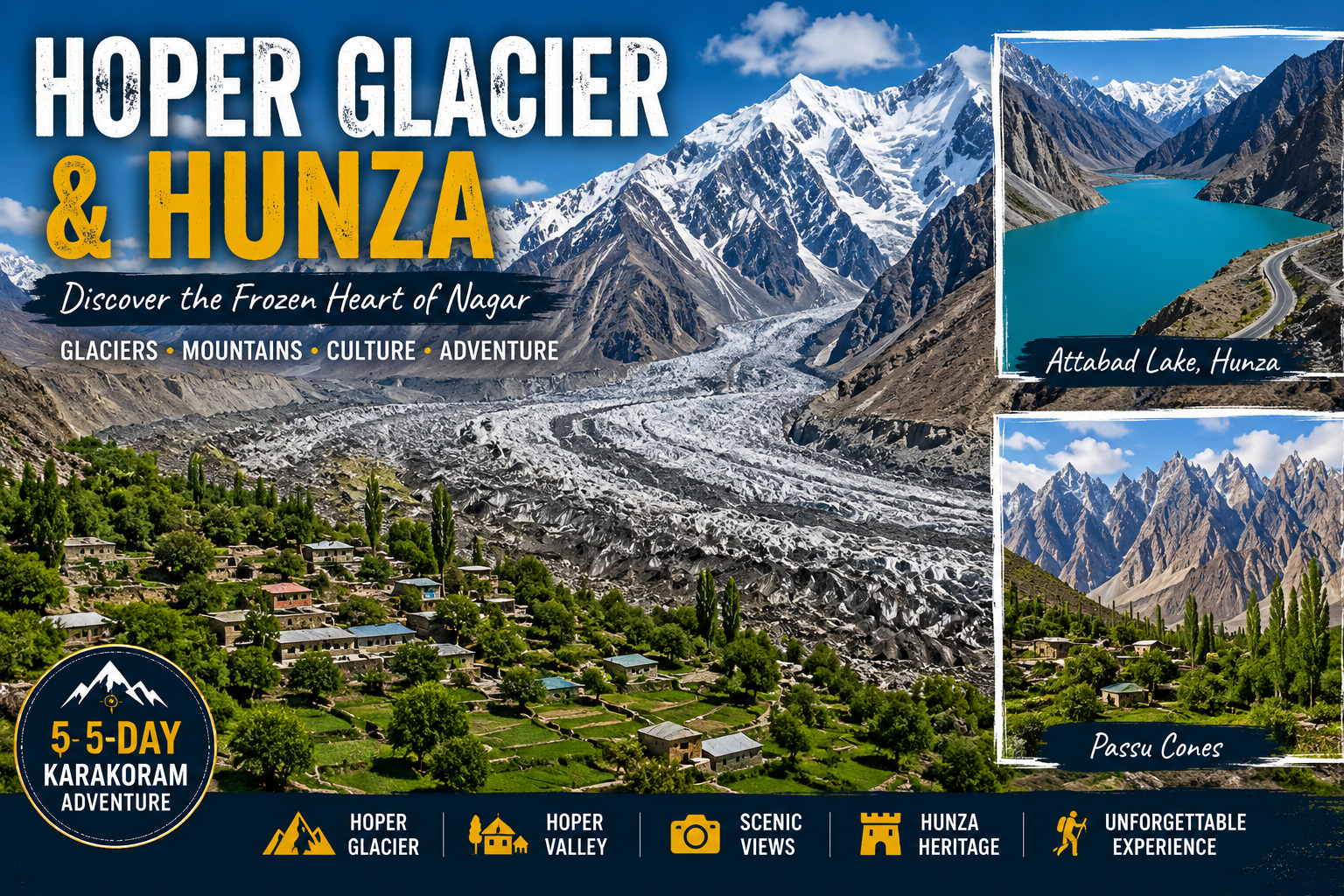
Many international travelers know Hunza for Attabad Lake, Baltit Fort, Passu Cones, and the Karakoram Highway. Yet just across the Hunza River lies Nagar, home to dramatic mountain scenery, traditional villages, Rakaposhi viewpoints, and the remarkable glacier landscape commonly known to visitors as Hoper Glacier.
For travelers who want to experience a Karakoram glacier without committing to a long expedition such as K2 Base Camp or a multi-day high-altitude trek to Rush Lake, Hoper offers an excellent alternative.
This guide explores Hoper Glacier, Hoper Valley, Nagar, and Hunza, including how to visit, what to see, when to go, whether hiking is necessary, and how to combine the region into an unforgettable 5-day northern Pakistan tour.
Where Is Hoper Glacier in Pakistan?
Hoper Glacier is located in the Hoper Valley area of Nagar District in Gilgit-Baltistan, northern Pakistan.
One important geographical point often causes confusion online:
Hoper Glacier is in Nagar, not Hunza District.
However, Hunza and Nagar are neighboring valleys separated by the Hunza River and connected by the Karakoram Highway and local roads.
Because Karimabad, Hunza, is a major tourist base, many visitors travel to Hoper as a day trip from Hunza. This is why search results and tour advertisements frequently use terms such as:
Hoper Glacier Hunza
or
Hopper Glacier Hunza.
For travelers, these search terms are understandable, but geographically the more accurate description is:
Hoper Glacier, Hoper Valley, Nagar District, Gilgit-Baltistan, Pakistan.
This close proximity is actually an advantage.
It means you can combine Nagar and Hunza in a single journey.
Hoper, Hopar or Hopper Valley: Which Name Is Correct?
You may encounter several spellings while researching your trip:
Hoper Valley
Hopar Valley
Hopper Valley
All are commonly used online to describe the same general destination.
The spelling variation can sometimes confuse international travelers searching for hotels, maps, tours, and transportation.
If you search for Hoper Glacier, Hopar Glacier, or Hopper Glacier Pakistan, you will generally find information relating to the glacier landscape around Hoper in Nagar.
For travel planning, Adventure Touristik primarily uses Hoper Valley and Hoper Glacier, while recognizing the alternative spellings travelers may encounter.
What Makes Hoper Valley Special?
Hoper is not simply a place to photograph a glacier.
The real beauty of the valley comes from its contrasts.
Imagine standing among cultivated fields and traditional mountain settlements.
Fruit trees grow nearby.
Local families continue agricultural traditions that have existed for generations.
Then you look toward the mountains.
Suddenly, the landscape changes completely.
Dark glacier ice and enormous moraine formations fill the valley below rugged Karakoram peaks.
This meeting of human settlement, agriculture, glacier systems, and high mountains gives Hoper its distinctive character.
It is a place where you can experience both the natural and cultural landscapes of Gilgit-Baltistan within a relatively small geographical area.
Understanding Hoper Glacier and Bualtar Glacier
Visitors researching the area may encounter different glacier names, particularly Hoper Glacier and Bualtar Glacier.
The Hoper area contains an interconnected and complex glacier environment, with Bualtar and Barpu among the glacier names commonly associated with the valley.
In everyday tourism language, visitors frequently use the broader term Hoper Glacier for the glacier scenery they experience from Hoper.
One thing often surprises first-time visitors.
Not every glacier looks white.
Large sections can appear grey, brown, or almost black.
Why?
Because glaciers transport enormous amounts of:
-
Rock
-
Gravel
-
Sand
-
Sediment
-
Mountain debris
This material accumulates across parts of the glacier surface, creating a dramatic mixture of ice and moraine.
Underneath that rocky appearance can lie moving glacier ice.
This is also why visitors should never assume that apparently solid terrain is safe to cross without local knowledge.
Do You Need to Trek to See Hoper Glacier?
This is one of the best things about visiting Hoper.
You do not need to complete a multi-day trek simply to experience the glacier landscape.
Travelers can reach Hoper Valley by road and visit viewpoints from which impressive glacier scenery can be observed.
Depending on your fitness, available time, weather, and trail conditions, you may also take a short guided hike toward a closer viewpoint or glacier environment.
This makes Hoper particularly appealing to travelers who want a soft-adventure experience.
You can see a major Karakoram glacier landscape without spending a week camping in the mountains.
However, getting closer to glacier terrain is very different from simply viewing it.
Active glaciers can contain:
-
Hidden crevasses
-
Unstable ice
-
Loose moraine
-
Falling rocks
-
Changing meltwater channels
-
Unstable slopes
Never walk onto unfamiliar glacier terrain simply because other people appear to have done so.
A local guide familiar with current conditions is strongly recommended for any glacier-related hiking.
Is Hoper Glacier Worth Visiting?
If you are already traveling to Hunza, Hoper Valley is absolutely worth considering.
Many standard Hunza itineraries follow a predictable route:
Karimabad.
Attabad Lake.
Hussaini Bridge.
Passu.
Khunjerab Pass.
These are excellent destinations, but adding Nagar creates a different experience.
Hoper gives you something that Central and Upper Hunza itineraries do not always provide so easily:
A close encounter with a dramatic glacier landscape combined with traditional village scenery.
The drive itself is part of the experience.
You leave the main Karakoram Highway and travel deeper into Nagar, where the landscape becomes quieter and increasingly rural.
For photographers, nature lovers, geographers, hikers, and anyone interested in glaciers, Hoper can become one of the highlights of a northern Pakistan journey.
The Perfect Combination: Gilgit, Hoper Glacier, Nagar and Hunza
If you have around five days, you do not need to choose between Hoper and Hunza.
Visit both.
A carefully designed 5-day Hoper Glacier and Hunza tour can combine very different experiences without requiring a long trekking expedition.
Here is how such a journey can unfold.
Day 1: Gilgit to Nagar and Hoper Valley
Begin your journey from Gilgit, one of the main gateways to northern Pakistan.
Travel north toward Nagar along the legendary Karakoram Highway.
This road is not simply transportation.
It is part of the adventure.
Mountains rise dramatically on both sides while the river cuts through the valleys below.
One of the essential stops is Rakaposhi View Point.
Rakaposhi, rising approximately 7,788 meters, is one of the great mountains of the Karakoram.
When weather conditions are clear, the mountain creates an extraordinary backdrop above Nagar.
After enjoying the viewpoint, continue toward Hoper Valley.
As you move away from the main highway, the landscape changes.
Villages become smaller.
Terraced fields appear.
The glacier-covered mountains seem increasingly close.
Spend the evening in or near Hoper, surrounded by the silence of Nagar’s mountain landscape.
Day 2: Explore Hoper Valley and Hoper Glacier
The second day should be dedicated to Hoper itself.
Visit a glacier viewpoint and take time to understand the scale of the landscape.
Photographs rarely communicate how enormous glaciers really are.
From above, what initially appears to be a field of rocks may actually be debris-covered ice stretching through the valley.
Travelers interested in walking can consider a guided short hike, subject to local conditions.
But there is no requirement to cross the glacier.
In fact, for a short sightseeing tour, a glacier crossing is unnecessary.
Instead, spend time exploring the wider valley.
Walk through villages.
Observe traditional agriculture.
Photograph the contrast between green fields and frozen mountains.
Try local food when available.
Talk with local people respectfully.
Hoper is much more rewarding when you experience it as a living mountain community rather than simply a photo stop.
Day 3: From Hoper Valley to Historic Hunza
After experiencing Nagar, cross toward neighboring Hunza Valley.
The transition is fascinating because although the valleys are geographically close, each has its own history and identity.
Make your way to Karimabad, the historic heart of Hunza.
Two landmarks deserve particular attention.
Baltit Fort
Perched above Karimabad, Baltit Fort is one of the most recognizable cultural landmarks in Gilgit-Baltistan.
Its architecture and strategic location reflect centuries of Hunza’s history.
The elevated setting also provides excellent views across the valley.
Altit Fort
Altit is another important historic settlement.
Explore Altit Fort and the surrounding old village environment, where traditional architecture provides a glimpse into the region’s past.
Afterward, walk through Karimabad Bazaar.
You can find local products including handicrafts, dried fruits, gemstones, clothing, and souvenirs.
If the weather cooperates, end your day at Duikar/Eagle’s Nest.
Sunset from this elevated viewpoint can be spectacular.
From here, the relationship between Hunza, Nagar, and the surrounding mountains becomes much easier to understand.
Day 4: Attabad Lake, Hussaini Bridge and Passu
No short Hunza journey would be complete without traveling into Upper Hunza, or Gojal.
Follow the Karakoram Highway north.
Your first major stop is Attabad Lake.
The lake’s brilliant turquoise water surrounded by barren mountains has become one of Pakistan’s most recognizable travel images.
Visitors can enjoy viewpoints and, depending on weather and operating conditions, optional boating.
Continue north toward Hussaini Suspension Bridge.
The bridge has become famous internationally through travel photography and social media.
Crossing is optional.
Travelers uncomfortable with heights can simply enjoy the landscape from nearby.
Then continue toward one of the great visual icons of northern Pakistan:
The Passu Cones
Also known as the Passu Cathedral, these sharply pointed mountains rise dramatically above the Karakoram Highway.
Their unusual shape makes Passu one of the finest photography locations in Hunza.
If time allows, your Upper Hunza exploration can also include places such as:
-
Gulmit
-
Borith Lake
-
Passu village
-
Ondra Poygah viewpoint
-
Local Wakhi cultural sites
The important thing is not to rush.
Hunza is best experienced slowly.
Day 5: Return to Gilgit
On the final day, return toward Gilgit through the Hunza-Nagar corridor.
The drive gives you another opportunity to appreciate how dramatically the landscapes of northern Pakistan change over relatively short distances.
Within five days, you can experience:
Glaciers in Hoper.
Villages in Nagar.
Rakaposhi.
Historic forts in Hunza.
Turquoise Attabad Lake.
Hussaini Bridge.
Passu Cones.
And one of the world’s great mountain highways.
For travelers with limited vacation time, this is an impressive amount of diversity within a compact itinerary.
Hoper Glacier vs Rush Lake Trek: Which Should You Choose?
Travelers researching Hoper frequently encounter information about Rush Lake.
That is because Hoper serves as an important gateway to trekking routes leading into the high mountains.
However, visiting Hoper Glacier and trekking to Rush Lake are completely different experiences.
Choose a Hoper Glacier & Hunza Tour if:
You have limited time.
You prefer hotels instead of multi-day camping.
You want relatively easy sightseeing.
You are traveling with family.
You want to combine culture and nature.
You want glacier views without a high-altitude expedition.
Choose the Rush Lake Trek if:
You want a serious multi-day trekking experience.
You are physically fit.
You are prepared for camping.
You want to reach approximately 4,694 meters.
You are comfortable with high-altitude conditions.
You want to experience deeper glacier and alpine landscapes.
A traveler can visit Hoper without trekking to Rush Lake.
But for trekkers, Hoper can be the beginning of a much bigger adventure.
Hoper Glacier vs Passu Glacier
Another question travelers may have is whether to visit Hoper or Passu.
Both areas offer impressive glacier and mountain scenery, but the experiences are different.
Hoper Valley combines traditional Nagar settlements with dramatic debris-covered glacier landscapes and opportunities for short hiking.
Passu, in Upper Hunza/Gojal, is famous for the Passu Cones and access to several surrounding natural attractions.
The good news?
You do not necessarily need to choose.
A well-planned five-day itinerary can include Hoper Valley and Passu.
This creates a much more diverse journey across Nagar, Central Hunza, and Upper Hunza.
When Is the Best Time to Visit Hoper Glacier?
The broad tourism season generally extends from approximately April to October, although conditions vary from year to year.
Each season offers something different.
April: Blossom Season
Spring can be magical.
Apricot, cherry, and other fruit trees bloom across parts of Hunza and Nagar while the mountains remain covered in snow.
The visual contrast is remarkable.
Exact blossom dates cannot be guaranteed because they depend on temperature, altitude, and annual weather patterns.
May and June: Green Valleys and Pleasant Travel
Late spring and early summer are excellent for sightseeing.
The valleys become increasingly green, temperatures are generally comfortable, and the main tourism season begins gaining momentum.
July and August: Main Summer Season
Summer is one of the busiest periods.
Most major attractions are accessible under normal conditions, and longer daylight hours provide plenty of time for sightseeing.
September: Excellent for Exploration
September can offer pleasant travel conditions with beautiful mountain light and fewer peak-season crowds in some areas.
October: Autumn Colors
For photographers, autumn can be extraordinary.
Trees across Hunza and Nagar transform into shades of:
Yellow.
Gold.
Orange.
Red.
Combine these colors with Hoper Glacier and snow-covered mountains, and you have one of northern Pakistan’s most beautiful seasonal landscapes.
Spring or Autumn: Which Is Better?
There is no single answer.
Choose spring if you love:
Blossoms.
Fresh green landscapes.
Snow-covered mountain backgrounds.
Spring photography.
Choose autumn if you love:
Golden trees.
Warm colors.
Dramatic photography.
Cooler mountain atmosphere.
If you can visit northern Pakistan more than once, experience both.
The same valley can look like an entirely different destination in another season.
Can Families Visit Hoper Glacier?
Yes, particularly if the trip is designed as a sightseeing tour rather than a trekking expedition.
Families can travel by vehicle into Hoper Valley and enjoy glacier viewpoints without attempting difficult glacier crossings.
An itinerary can be customized for:
-
Families with children
-
Older travelers
-
Couples
-
Photography groups
-
Travelers with limited hiking experience
Short walks can be adjusted according to fitness.
The key is understanding that seeing a glacier does not mean you need to walk on it.
For many visitors, the safest and most enjoyable experience is simply observing the glacier from an appropriate viewpoint.
Do You Need a 4x4 for Hoper Valley?
Vehicle requirements can vary depending on current road conditions, season, weather, and the exact places you intend to visit.
Mountain roads change.
Construction, landslides, rain, and seasonal conditions can affect access.
For this reason, travelers should confirm the current situation locally rather than relying on a travel blog written several years earlier.
Adventure Touristik can arrange an appropriate vehicle according to the latest route conditions and group size.
What Should You Pack?
A short Hoper and Hunza tour does not require expedition equipment, but mountain weather can change quickly.
Useful items include:
-
Comfortable walking shoes
-
Light hiking shoes if planning short hikes
-
Warm jacket
-
Layered clothing
-
Rain/windproof outer layer
-
Sunglasses
-
Sunscreen
-
Sun hat
-
Reusable water bottle
-
Small backpack
-
Camera or smartphone
-
Power bank
-
Personal medications
Even during summer, evenings can become cool.
At higher elevations, strong sunlight can also be deceptive.
Sun protection is important.
Photography Tips for Hoper Valley
Hoper is particularly rewarding for landscape photographers because of its contrasts.
Photograph the Glacier with Human Scale
Including a person at a safe viewpoint helps communicate the enormous scale of the glacier.
Capture Village and Glacier Together
One of Hoper’s strongest visual stories is the relationship between cultivated land and the frozen landscape.
Visit During Morning or Evening Light
Lower-angle sunlight can add texture to mountain faces and glacier terrain.
Photograph Rakaposhi from Nagar
Clear weather can provide spectacular mountain views.
Do Not Ignore Local Life
Architecture, agriculture, orchards, and village landscapes are equally important parts of the story.
Always ask permission before taking close photographs of local residents.
Responsible Tourism in Hoper and Hunza
Tourism is growing rapidly across Gilgit-Baltistan.
That growth brings economic opportunities, but it also creates challenges.
Plastic waste.
Traffic.
Pressure on water resources.
Uncontrolled construction.
Environmental damage.
Visitors can help.
Carry reusable water bottles.
Avoid leaving rubbish.
Do not throw waste near glaciers.
Respect agricultural land.
Do not enter private property without permission.
Support locally owned businesses.
Hire local guides.
Respect local customs.
A glacier valley should not become a dumping ground simply because it became popular on social media.
The landscapes of Hoper, Nagar, and Hunza belong to future generations too.
Frequently Asked Questions About Hoper Glacier
Where is Hoper Glacier?
Hoper Glacier is located in the Hoper/Hopar Valley area of Nagar District, Gilgit-Baltistan, Pakistan.
Is Hoper Glacier in Hunza?
Geographically, Hoper is in Nagar District, neighboring Hunza. It is often called “Hoper Glacier Hunza” online because many tourists visit it from Karimabad, Hunza.
Is Hoper Glacier the same as Bualtar Glacier?
Bualtar Glacier is closely associated with the glacier system around Hoper, and tourism references sometimes use “Hoper Glacier” more broadly for the glacier landscape visitors see in the valley.
Can I visit Hoper Glacier from Hunza?
Yes. Hoper is commonly visited from the Central Hunza/Karimabad area, subject to current road conditions.
Do I have to trek to see Hoper Glacier?
No. Glacier views can be experienced without undertaking a multi-day trek. Optional short hiking may be possible depending on current conditions.
Can I walk on Hoper Glacier?
Independent glacier walking is not recommended. Active glaciers can contain hidden crevasses, unstable moraine, moving ice, and rockfall hazards. Any glacier-related hiking should be undertaken with appropriate local guidance.
Is Hoper Glacier suitable for children?
A sightseeing visit can be suitable for families because difficult trekking is not required. Activities should be adjusted according to age and fitness.
What is the best time to visit Hoper Valley?
Generally, April through October offers the broadest travel window. Spring is popular for blossoms, summer for general sightseeing, and autumn for colorful landscapes.
Can I visit Hoper Glacier and Attabad Lake on the same tour?
Yes. A multi-day itinerary can easily combine Hoper/Nagar with Hunza attractions such as Attabad Lake, Karimabad, Hussaini Suspension Bridge, and Passu.
How many days are enough for Hoper and Hunza?
Five days provides a good introduction if starting and ending in Gilgit. Travelers with more time should consider 7–10 days for a slower itinerary or additional destinations.
Is Rush Lake near Hoper?
Hoper is a gateway for trekking routes toward the high mountains and Rush Lake region. Reaching Rush Lake requires a separate multi-day, high-altitude trekking itinerary.
Why You Should Add Nagar to Your Hunza Trip
Hunza deserves its international reputation.
But northern Pakistan becomes much more interesting when travelers explore beyond the most famous places.
Across the river lies Nagar.
And within Nagar lies Hoper.
Here, villages sit beside enormous glacier systems.
Agricultural terraces rise beneath some of the greatest mountains of the Karakoram.
Rakaposhi dominates the horizon.
Roads lead from inhabited valleys toward landscapes of ice and rock.
This is precisely what makes a combined Hoper Glacier, Nagar, and Hunza tour so rewarding.
You are not seeing one version of Gilgit-Baltistan.
You are seeing several.
Experience Hoper Glacier, Nagar & Hunza with Adventure Touristik
A five-day journey through this region can tell an extraordinary story of northern Pakistan.
Day one: Leave Gilgit and enter the mountains of Nagar.
Day two: Stand above the ancient ice of Hoper’s glacier landscape.
Day three: Cross into Hunza and explore centuries of history in Karimabad, Baltit, and Altit.
Day four: Follow the Karakoram Highway toward turquoise Attabad Lake, Hussaini, and the spectacular Passu Cones.
Day five: Return through one of the most dramatic mountain corridors in Asia.
Five days.
Two neighboring valleys.
Glaciers, culture, lakes, villages, ancient forts, and the Karakoram.
Adventure Touristik offers private and customized Hoper Glacier, Nagar and Hunza tours for 2026–2030, with itineraries that can be adapted for international travelers, families, couples, photographers, and private groups.
For tour planning and bookings, contact Adventure Touristik via WhatsApp or mobile at +92 355 5808382.