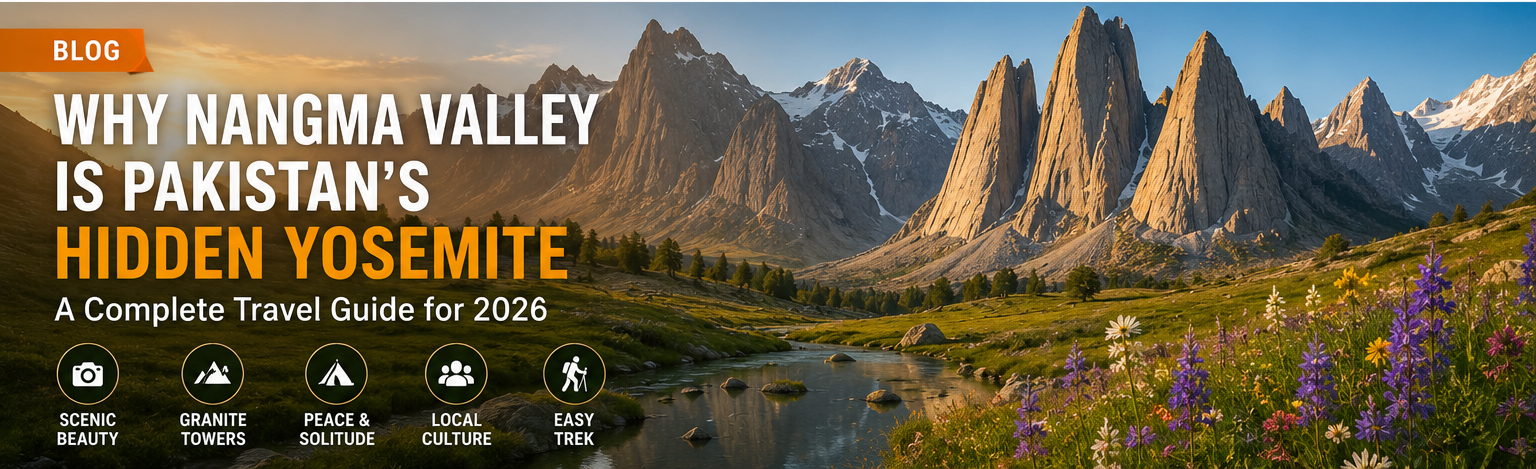
Nangma Valley Trek (2026–2030) – Complete Travel Guide
Far from the busy tourist routes of northern Pakistan, Nangma Valley offers a different kind of mountain experience. The valley lies in the remote landscapes of Gilgit-Baltistan, where enormous granite walls rise above green meadows, clear streams run through the valley floor, and traditional Balti villages still retain their quiet character.
For trekkers, Nangma Valley is not simply another destination to tick off a Pakistan travel list. It is a journey into the heart of the Karakoram, combining short but rewarding trekking, dramatic mountain scenery, local culture, camping, and opportunities to explore one of Pakistan's best-known granite climbing areas.
The valley is often described as the “Yosemite of Pakistan” because of its towering granite formations. The comparison comes from the scale and vertical character of the rock walls rather than from the landscapes being identical. The experience is distinctly Karakoram: remote, rugged, quiet, and deeply connected to the surrounding mountains.
This complete Nangma Valley Trek guide for 2026–2030 explains where Nangma Valley is located, how to reach it, when to go, what the trek is like, what to pack, where to stay before and after the trek, how local transport works, and what travelers should consider before starting the journey.
Table of Contents
- Where Is Nangma Valley?
- Why Visit Nangma Valley?
- How to Reach Nangma Valley
- Kanday Village: The Gateway to the Trek
- Nangma Valley Trek Route
- Mingulu Broq and the Upper Valley
- Granite Towers and Amin Brakk
- Nangma Valley Trek Distance and Difficulty
- Best Time to Visit Nangma Valley
- Nangma Valley Weather
- Altitude and Acclimatization
- Camping and Accommodation
- Food and Balti Culture
- Things to Do in Nangma Valley
- What to Pack for the Trek
- Essential Travel Tips
- Safety and Responsible Travel
- Combining Nangma Valley with Khaplu
- Planning Your Nangma Valley Trek 2026–2030
- Frequently Asked Questions
Where Is Nangma Valley?
Nangma Valley is located in Ghanche District, Gilgit-Baltistan, Pakistan, in the eastern part of the Karakoram region. The trekking journey begins from Kanday village, a small settlement that serves as the main gateway to the valley.
Travelers normally approach the region through Skardu and Khaplu. From Khaplu, the route continues towards Kanday, where the road journey gives way to trekking.
The surrounding landscape is characteristic of Baltistan: dry mountain slopes, green agricultural fields around settlements, glacial streams, dramatic rock faces, and high peaks rising above the valleys.
For travelers who want to experience a quieter side of Gilgit-Baltistan, Nangma Valley provides an excellent alternative to some of the more heavily visited destinations in northern Pakistan.
Why Visit Nangma Valley?
The biggest attraction of Nangma Valley is the contrast between its relatively accessible trekking route and its enormous mountain scenery.
Within a comparatively short trek, visitors move from traditional village landscapes into open pastures and then into a dramatic mountain amphitheater surrounded by granite towers.
Nangma Valley is particularly attractive for:
- Trekking and hiking
- Mountain photography
- Camping under clear Karakoram skies
- Rock climbing and mountaineering interests
- Nature and landscape photography
- Travelers interested in remote destinations
- Visitors wanting to experience Balti culture
- Adventure travelers exploring lesser-known parts of Gilgit-Baltistan
Unlike destinations dominated by large hotels and commercial tourism, the Nangma Valley experience is based around nature, walking, camping, and local communities.
How to Reach Nangma Valley
Getting to Nangma Valley is part of the adventure. The trek itself begins at Kanday, but travelers first need to reach the wider Baltistan region.
Islamabad to Skardu
The fastest option is normally a flight from Islamabad to Skardu. The flight offers spectacular views of the northern mountains when weather conditions are suitable.
Because flights to Skardu can be affected by mountain weather, travelers should keep some flexibility in their schedule. A road journey through the Karakoram is another option when flights are unavailable or when travelers want to experience more of the overland route.
Skardu to Khaplu
From Skardu, the journey continues towards Khaplu through the spectacular landscapes of Baltistan. The route follows major river valleys and passes through traditional settlements before reaching Khaplu.
Khaplu is an excellent place to spend time before the trek, particularly for travelers who want additional acclimatization and a chance to explore Balti culture.
Khaplu to Kanday
From Khaplu, the journey continues towards Kanday village. Local transport and 4x4 vehicles are commonly used for the more remote sections of the route.
Once you reach Kanday, the road journey ends and the trekking experience begins.
Kanday Village: The Gateway to the Trek
Kanday village is the traditional starting point for the Nangma Valley trek. It is a useful place to organize final trekking arrangements, including local support, porters, guides, food supplies, and transport.
The village also provides an opportunity to see everyday life in the Baltistan mountains. Fields, traditional houses, irrigation channels, and mountain scenery create a completely different atmosphere from the cities of Pakistan.
Travelers should avoid treating Kanday simply as a trailhead. Local communities are an important part of the Nangma Valley experience, and spending money on local services directly supports the people who live in this remote region.
Nangma Valley Trek Route
The Nangma Valley trekking route is relatively short compared with many of the major multi-day treks in Pakistan, but the scenery becomes increasingly impressive as you move deeper into the valley.
The route generally progresses from:
Kanday Village → mountain pastures → Mingulu Broq → Nangma Valley → Amin Brakk area
The early part of the trek passes through agricultural land, grazing areas, streams, and open mountain landscapes.
As the trail continues, the landscape gradually changes. The mountains become larger, the valley narrows, and the enormous granite formations begin to dominate the horizon.
This gradual transformation is one of the most enjoyable aspects of the trek. You do not arrive immediately at the most dramatic scenery. Instead, the mountains reveal themselves step by step.
Mingulu Broq and the Upper Valley
Mingulu Broq is one of the important areas along the trekking route and provides a beautiful setting for camping.
The open meadow environment is surrounded by mountain scenery and provides a natural transition between the lower trekking route and the dramatic upper valley.
Depending on your itinerary, Mingulu Broq can be used as a camping location or a stopping point during the trek. The area is particularly attractive in the evening when the surrounding peaks begin to change color as the sun moves behind the mountains.
At night, the lack of city lights creates excellent conditions for viewing the stars.
Granite Towers and Amin Brakk
The defining feature of Nangma Valley is its extraordinary granite architecture.
Massive rock walls and towers rise vertically from the surrounding landscape, creating the dramatic character for which the valley has become famous among trekkers and climbers.
Amin Brakk
Amin Brakk, also known as the Great Tower, is one of the most recognizable granite formations in the area.
Its enormous vertical face demonstrates why Nangma Valley has developed a reputation as one of Pakistan's important rock climbing environments.
You do not need to be a climber to appreciate these mountains. For trekkers and photographers, simply reaching the base area and looking up at the enormous walls can be one of the most memorable moments of the journey.
Other granite formations, including the Grey Tower and Changi Tower, add to the dramatic landscape.
Nangma Valley Trek Distance and Difficulty
The total trekking distance depends on the route selected and any side trips included in the journey. A typical trekking experience covers approximately 8 to 12 kilometers, while the main trekking experience can generally be completed over 2 to 3 days.
The trek is commonly considered easy to moderate, but altitude should not be underestimated.
The trail includes natural mountain terrain, uneven sections, streams, and gradual elevation gain. Weather can also change quickly in the Karakoram.
A person with reasonable fitness and regular walking experience can enjoy the trek, while experienced trekkers can use the area for photography, exploration, side hikes, and climbing-related activities.
Best Time to Visit Nangma Valley
The main trekking season for Nangma Valley is generally June to September.
During this period, the lower and middle sections of the valley become greener, the meadows are more attractive, and trekking conditions are generally more favorable.
June
June marks the beginning of the main trekking season. Higher sections can still retain snow, so conditions may vary from year to year.
July and August
July and August are among the most popular months for trekking. Meadows are greener, access is generally easier, and the valley offers excellent conditions for photography and camping.
September
September can be an excellent choice for travelers looking for quieter trails and changing mountain colors. Temperatures begin to fall, especially at night.
Winter
Winter brings significant snowfall to the higher areas. Conditions can become difficult and access may not be practical for ordinary trekking trips.
For a standard Nangma Valley trekking holiday, the summer trekking season is the safer and more practical choice.
Nangma Valley Weather
Mountain weather should always be taken seriously when planning a Nangma Valley trek.
Summer days can be relatively pleasant, but nights at higher elevations can become very cold. Cloud, rain, wind, and temperature changes can occur quickly.
Trekkers should therefore prepare for several conditions rather than relying on a single weather forecast.
- Cool daytime temperatures
- Cold nights
- Possible rain and cloud
- Strong sun at higher elevations
- Cold winds around exposed mountain areas
- Rapid weather changes
Always check local conditions before leaving Kanday and ask your guide or local support team about current trail conditions.
Altitude and Acclimatization
Altitude is one of the most important factors to consider when planning the Nangma Valley trek.
The route starts around Kanday at approximately 3,200 meters and climbs higher towards the upper Nangma Valley and Amin Brakk area.
For travelers arriving from lower elevations, this increase can be significant even though the trek itself is not extremely long.
Spending time in Skardu or Khaplu before starting the trek can help your body adjust gradually to the altitude.
Walk at a comfortable pace, drink enough water, eat properly, and communicate with your guide if you feel unwell. Altitude-related symptoms should never be ignored.
Camping and Accommodation
There are no luxury hotels inside Nangma Valley, and that is part of its attraction.
The valley is primarily a trekking and camping destination. Travelers normally arrange camping equipment and food support before entering the remote sections of the route.
Kanday can provide basic accommodation and local services, while Khaplu offers a wider range of hotels and guesthouses.
Skardu provides the largest selection of accommodation, making it convenient for travelers who want to spend additional nights before or after the trek.
During the main trekking season, advance arrangements are recommended, especially for groups traveling with guides, porters, camping equipment, or private vehicles.
Food and Balti Culture
A Nangma Valley journey is also an opportunity to experience the culture of Baltistan.
The villages around the trekking route are home to Balti communities whose traditional lifestyle remains closely connected with agriculture, livestock, mountains, and local trade.
Food in remote trekking areas is generally simple and practical. Travelers can expect meals based around rice, bread, vegetables, lentils, soup, and other locally available ingredients.
Traditional tea and warm drinks are particularly welcome after a cold day in the mountains.
Visitors should respect local customs, dress appropriately in villages, ask before photographing people, and avoid treating local communities simply as part of the tourist scenery.
Things to Do in Nangma Valley
Although trekking is the main reason people visit, there is much more to experience in the valley.
- Trek through the Karakoram: Walk from Kanday towards Mingulu Broq and the upper valley.
- Explore granite formations: Spend time around the dramatic rock towers and mountain walls.
- Photography: Capture meadows, streams, traditional villages, granite towers, and changing mountain light.
- Camping: Spend a night beneath the Karakoram sky away from city lights.
- Short side hikes: Explore nearby viewpoints, streams, meadows, and mountain slopes.
- Rock climbing interest: Experienced climbers can explore the area's famous granite environment with appropriate technical support.
- Experience Balti villages: Spend time around Kanday and nearby communities before or after the trek.
- Explore Khaplu: Add cultural and historical experiences to the mountain journey.
What to Pack for the Nangma Valley Trek
Even though the Nangma Valley trek is relatively short, travelers should pack for high-altitude mountain conditions.
Essential clothing
- Warm jacket
- Fleece or insulating mid-layer
- Waterproof rain jacket
- Thermal layers
- Comfortable trekking trousers
- Warm socks
- Gloves and warm hat
Trekking equipment
- Strong trekking shoes or boots
- Daypack
- Headlamp
- Water bottle or hydration system
- Walking poles
- Personal first-aid supplies
- Sunglasses
- Sunscreen and lip protection
Personal essentials
- Power bank
- Personal medication
- Toiletries
- Identification documents
- Cash for remote areas
- Reusable water bottle
- Small personal waste bag
If you are joining an organized trekking expedition, confirm in advance which camping equipment, meals, porter services, and safety equipment are included.
Essential Travel Tips for Nangma Valley
A little preparation can make the difference between a stressful mountain trip and an enjoyable one.
- Plan extra time: Mountain transport and flights can be affected by weather.
- Acclimatize first: Do not rush directly into the higher sections after arriving in Baltistan.
- Carry cash: Remote villages have limited banking facilities.
- Arrange local transport: Confirm 4x4 transport before traveling into remote areas.
- Use local support: Local guides and porters understand the terrain and changing conditions.
- Pack light but properly: Carry only what you need while ensuring you have adequate protection against cold and rain.
- Check conditions: Ask about current weather and trail conditions before starting.
- Keep your schedule flexible: Do not build a trip around tight flight or transport connections.
Safety and Responsible Travel
Nangma Valley is remote, and travelers should approach the trek with the same respect they would give any high-altitude mountain environment.
Do not leave the marked or locally established trail without understanding the terrain. Streams, loose rocks, steep slopes, and rapidly changing weather can create hazards.
For visitors unfamiliar with the region, hiring a knowledgeable local guide is strongly recommended. A guide can help with route navigation, local communication, weather decisions, and arrangements with porters or transport providers.
Responsible tourism is equally important. Carry your rubbish back, avoid damaging vegetation, keep noise low, and respect villages, grazing areas, wildlife, and water sources.
The beauty of Nangma Valley depends on keeping the valley clean and protecting the character that makes it special.
Combining Nangma Valley with Khaplu
One of the best ways to make the journey more meaningful is to combine the trek with time in Khaplu.
Khaplu provides a cultural contrast to the wilderness of Nangma Valley. Travelers can explore historic architecture, traditional Balti settlements, mountain landscapes, and local food before or after the trek.
Khaplu Fort is particularly worthwhile for travelers interested in the history and heritage of Baltistan.
This combination creates a more balanced northern Pakistan journey: culture and history in Khaplu followed by trekking and wilderness in Nangma Valley.
If you are exploring several destinations in Pakistan, you can also connect the trip with other mountain and cultural destinations depending on the available travel time.
Planning Your Nangma Valley Trek 2026–2030
The best Nangma Valley trip is not necessarily the longest one. Because the valley is relatively remote, good planning is more important than trying to cover too many places in a short period.
For a Nangma Valley Trek 2026–2030, travelers should consider the following before booking:
- Preferred trekking month
- Number of travelers
- Fitness level
- Required acclimatization time
- Skardu and Khaplu accommodation
- 4x4 transport to Kanday
- Local guide and porter requirements
- Camping equipment
- Weather flexibility
- Domestic flight backup plans
Travelers coming from Islamabad should ideally avoid creating an itinerary with no spare days. Mountain flights and road journeys can experience delays, and a flexible schedule makes the overall trip much more comfortable.
For visitors traveling with families or larger groups, private transport can make the journey easier. Adventure travelers can also combine Nangma Valley with other destinations in Baltistan to create a longer custom itinerary.
For transport arrangements in Pakistan, see our Car Rental in Pakistan guide and explore suitable Hiace Grand Cabin rental options for larger groups.
Explore More Mountain and Cultural Destinations
Nangma Valley can be part of a wider Pakistan adventure rather than a standalone trip.
If you are interested in exploring the country's mountain landscapes, our National Parks of Pakistan guide provides another starting point for discovering protected landscapes across the country.
Travelers interested in forest landscapes can also explore Sharan Forest in Kaghan Valley, while those planning northern Pakistan holidays may want to see our Hunza Tour Packages.
For travelers who want to combine outdoor adventures with local culture, the Kalash Chilam Joshi Festival in Chitral offers a completely different cultural experience in northern Pakistan.
If you are planning a private trip rather than joining a fixed departure, you can also explore our Custom Tour service and build an itinerary around your preferred destinations, dates, transport, and trekking experience.
Frequently Asked Questions About Nangma Valley Trek
Where is Nangma Valley located?
Nangma Valley is located in Ghanche District of Gilgit-Baltistan, Pakistan. The main trekking route begins from Kanday village near Khaplu.
How do I reach Nangma Valley from Islamabad?
The most practical route is generally to travel from Islamabad to Skardu, continue by road towards Khaplu, and then travel towards Kanday village. Travelers can also use the overland route through the Karakoram when suitable.
How far is Nangma Valley from Skardu?
The journey from Skardu towards the Nangma Valley region is approximately 65–70 kilometers by road, although actual travel time depends on the route, road conditions, and the final trailhead.
What is the starting point of the Nangma Valley trek?
Kanday village is the main starting point for the Nangma Valley trek. Local guides, porters, and basic accommodation can be arranged around the village.
How difficult is the Nangma Valley Trek?
The trek is generally considered easy to moderate. The route is relatively short, but the altitude and mountain terrain mean that reasonable fitness and proper acclimatization are important.
How long does the Nangma Valley Trek take?
The main trekking experience generally takes around 2–3 days, depending on the selected route, camping plan, side trips, weather, and pace.
What is the best time for the Nangma Valley Trek?
The main trekking season is generally from June to September. July and August are particularly suitable for travelers looking for greener meadows and more accessible summer trekking conditions.
Is Nangma Valley suitable for beginners?
Trekkers with reasonable fitness and some walking experience can generally manage the main route. However, beginners should not underestimate the altitude and should consider traveling with an experienced local guide.
Do I need a guide for Nangma Valley?
A local guide is strongly recommended, particularly for travelers visiting the region for the first time. Local support can be valuable for navigation, transport, weather decisions, communication, and emergency situations.
Can I camp in Nangma Valley?
Yes. Camping is an important part of the Nangma Valley trekking experience. Travelers should arrange tents, sleeping equipment, food, and other camping requirements before entering the remote sections of the valley.
What are the main attractions of Nangma Valley?
The main attractions include green mountain meadows, clear streams, traditional Balti landscapes, dramatic granite towers, Amin Brakk, and the peaceful atmosphere of the remote Karakoram.
Why is Nangma Valley called the Yosemite of Pakistan?
Nangma Valley has earned this nickname because of its enormous vertical granite walls and towers that rise dramatically from the valley floor. The comparison refers mainly to its granite mountain landscape and climbing environment.
Can Nangma Valley be combined with Khaplu?
Yes. Khaplu is one of the best places to combine with a Nangma Valley trek. Travelers can experience Balti culture and heritage in Khaplu before heading into the mountains.
What should I pack for the Nangma Valley Trek?
Essential items include proper trekking shoes, warm layers, a waterproof jacket, gloves, a warm hat, sunglasses, sunscreen, water bottles, personal medication, a headlamp, and suitable camping equipment if it is not provided by your trekking operator.
Final Thoughts: Is Nangma Valley Worth Visiting?
Nangma Valley is one of the most rewarding short trekking destinations in Gilgit-Baltistan for travelers who want dramatic mountain scenery without committing to a long expedition.
The journey from Skardu and Khaplu to Kanday introduces travelers to the culture and landscapes of Baltistan, while the trek itself gradually leads into a spectacular world of green meadows, streams, and towering granite walls.
What makes Nangma Valley particularly special is its balance. It is adventurous without requiring an extremely long itinerary, remote without being inaccessible, and dramatic without being overwhelmed by mass tourism.
For 2026–2030, travelers looking for a genuine Karakoram trekking experience should consider Nangma Valley as part of their Pakistan adventure. Go prepared, allow enough time for acclimatization, respect the local communities, and leave the valley exactly as you found it.
If you are ready to plan your journey, contact Adventure Touristik to discuss your preferred dates, group size, transport requirements, trekking support, and custom Pakistan itinerary.