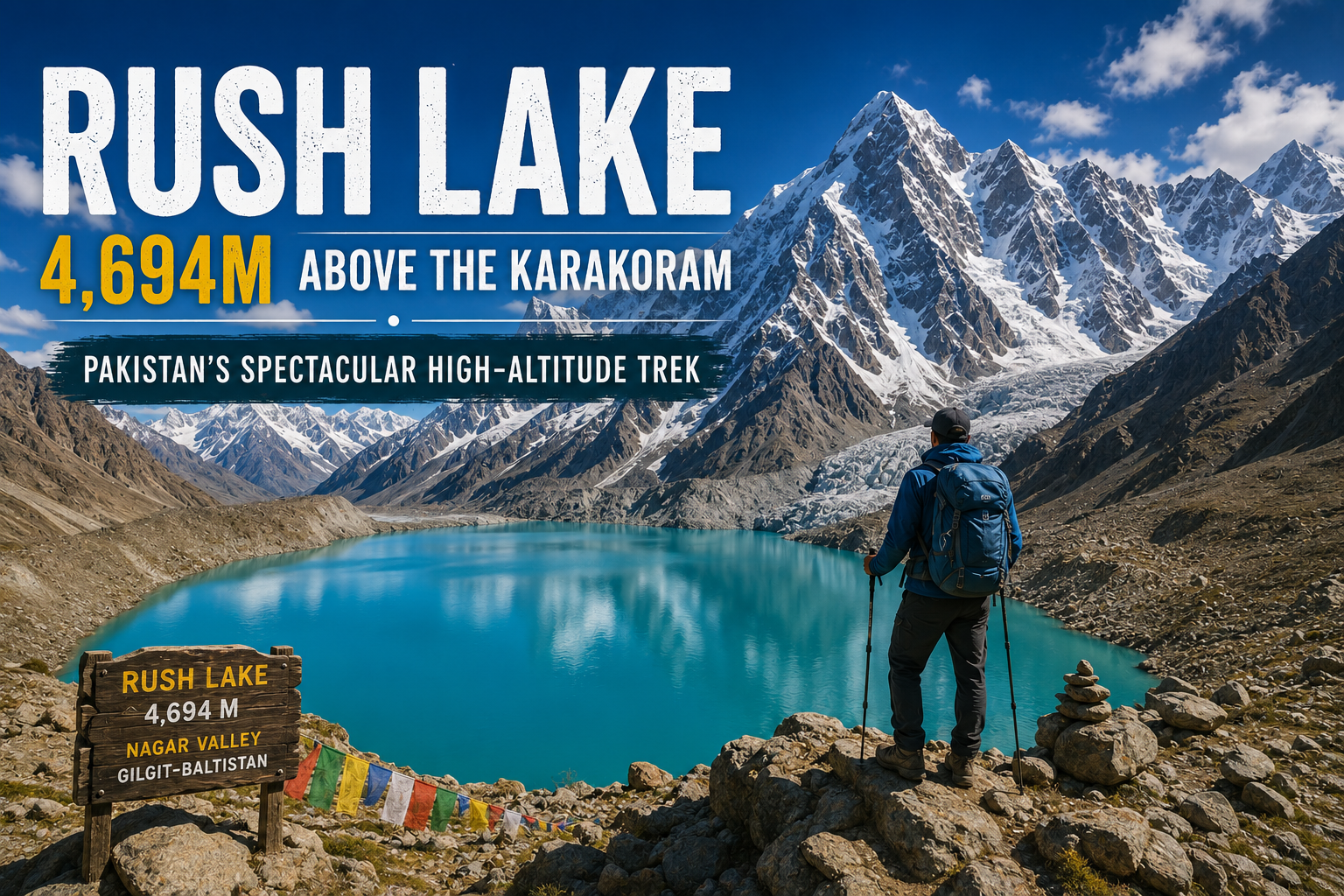
Rush Lake Trek Pakistan: Hiking to a Spectacular High-Altitude Lake in the Karakoram
Imagine waking before sunrise in the high mountains of northern Pakistan.
Outside your tent, the air is cold and thin. The first sunlight begins touching snow-covered peaks while an alpine lake rests quietly beneath the enormous mountains of the Karakoram.
You are standing nearly 4,700 meters above sea level.
This is Rush Lake.
Located high above Hoper Valley in Nagar District, Gilgit-Baltistan, Rush Lake is one of Pakistan’s best-known high-altitude alpine trekking destinations and one of the most rewarding adventures for travelers exploring the Hunza-Nagar region.
The journey is relatively short compared with major Karakoram expeditions such as K2 Base Camp, but do not mistake shorter for easy.
Getting to Rush Lake means leaving the comfortable valleys behind, entering dramatic glacier terrain, climbing steep mountain trails and eventually reaching an altitude of approximately 4,694 meters (15,400 feet).
For travelers searching for a genuine Pakistan trekking adventure between 2026 and 2030, Rush Lake deserves serious consideration.
This guide explains what makes the trek special, where Rush Lake is located, how difficult the journey is, the best time to go, what you may see along the route—and an important question many travelers ask:
Can you really see K2 from Rush Lake?
Let’s explore.
Where Is Rush Lake in Pakistan?
Rush Lake is located in the mountains above Hoper (also written Hopar) Valley in Nagar District, Gilgit-Baltistan.
Nagar lies directly across the Hunza River from the internationally famous Hunza Valley.
Because Hunza is much better known among international travelers, Rush Lake is sometimes described online as being in “Hunza.”
Geographically, however, the trekking route is associated more accurately with Nagar Valley and Hoper Valley.
The usual gateway is Hoper Village.
From here, trekkers leave the road network behind and enter one of the most dramatic mountain environments in northern Pakistan.
How High Is Rush Lake?
Rush Lake is generally reported at approximately:
4,694 meters
or approximately:
15,400 feet above sea level.
That is extremely high.
For comparison, many famous European Alpine summits are lower than Rush Lake.
At this elevation, the atmosphere contains significantly less oxygen than at sea level, making acclimatization and sensible pacing essential.
You may see Rush Lake described online as:
“Pakistan’s highest lake.”
Or:
“One of the highest alpine lakes in the world.”
These descriptions are widely used in tourism marketing, but altitude rankings for lakes can be complicated.
Definitions vary according to whether a water body is permanent or seasonal, its size, mapping accuracy and what qualifies as a “lake.”
A more reliable description is:
Rush Lake is one of Pakistan’s best-known and most spectacular high-altitude alpine lakes.
And frankly, when you are standing beside it at nearly 4,700 meters surrounded by the Karakoram, numerical rankings become much less important.
The landscape speaks for itself.
Why Is Rush Lake Trek So Special?
Pakistan has many extraordinary trekking routes.
Some take weeks.
Some require complicated expedition logistics.
Some travel deep into remote mountain systems.
Rush Lake offers something different.
It delivers a remarkable concentration of Karakoram scenery within a comparatively compact trekking journey.
The landscape changes dramatically over a relatively short distance.
You begin around inhabited valleys.
You see villages, orchards and terraced agricultural fields.
Then come glaciers.
Then steep mountain trails.
Then alpine landscapes.
And finally, high above everything else, Rush Lake.
This rapid transformation is one of the reasons the trek feels so adventurous.
The Journey Begins in Nagar Valley
For many international travelers, the adventure begins long before the first trekking day.
Most complete itineraries start in Islamabad before traveling north toward Gilgit-Baltistan.
The journey into northern Pakistan is itself unforgettable.
As you approach the Hunza-Nagar region, the landscape becomes increasingly dramatic.
The valleys narrow.
Mountains rise thousands of meters above the road.
The Hunza River cuts through the landscape.
Villages appear as green patches surrounded by enormous walls of rock.
Eventually, travelers reach the beautiful Hunza-Nagar region.
From here, the trekking journey moves toward Hoper.
Hoper Valley: Gateway to Rush Lake
Hoper is one of Nagar’s most spectacular mountain valleys.
The area is known for its dramatic glacier systems and proximity to some of the great mountains of the Karakoram.
The village landscape provides a striking contrast.
On one side:
Green agricultural terraces.
Fruit trees.
Traditional homes.
Village life.
On the other:
Glaciers.
Rock.
Ice.
And giant mountains.
It is from this environment that the Rush Lake adventure truly begins.
Once you leave Hoper behind, the landscape becomes increasingly wild.
Crossing the Glacier Landscape
One of the defining features of the Rush Lake Trek Pakistan is glacier terrain.
The Hoper region contains an extraordinary network of glaciers.
Depending on current route conditions, trekkers travel through or around sections of this dynamic environment while moving toward higher camps.
Walking near a glacier is very different from hiking on an ordinary mountain trail.
Glaciers move.
Routes change.
Streams appear and disappear.
Ice conditions evolve.
Rockfall and moraine terrain can create additional challenges.
This is one reason local knowledge is so important.
A GPS track downloaded several years ago cannot understand what a glacier looks like today.
An experienced local guide can.
What Is the Rush Lake Trek Route Like?
Different operators and guides may organize the route differently depending on weather, group fitness, campsite conditions and glacier changes.
A common trekking progression includes locations such as:
Hoper Village → Bericho Kor → Chidin Harai → Rush Lake → return through the Nagar/Hoper region.
Let’s look at the journey more closely.
Hoper to Bericho Kor
The first trekking stage introduces you immediately to the dramatic geography of Nagar.
Leaving the village environment behind, trekkers enter glacier-dominated terrain.
The mountains begin to feel much larger once you are traveling on foot.
Distances that appear short on a map suddenly become more meaningful.
Glacier crossings and moraine terrain require careful footing.
Eventually, trekkers reach the camping area around Bericho Kor, often at approximately 3,300 meters depending on the chosen campsite.
The first night in the mountains is an important transition.
Road travel is finished.
The trekking rhythm has begun.
Bericho Kor to Chidin Harai
This can be one of the physically demanding sections.
The route gains significant altitude.
Climbing becomes more sustained.
At higher elevations, even simple walking requires more effort.
The key is not speed.
It is rhythm.
Slow.
Steady.
Controlled.
As you gain elevation, the views become increasingly expansive.
Glaciers stretch below.
Mountain walls dominate the horizon.
The inhabited valleys begin to feel very far away.
The camp around Chidin Harai places trekkers firmly within the high-altitude environment.
Chidin Harai to Rush Lake
This is the day many trekkers have been waiting for.
The trail continues upward toward the lake.
With every step, the landscape becomes more alpine.
Then, finally:
Rush Lake.
At approximately 4,694 meters, the lake sits beneath an extraordinary Karakoram skyline.
Depending on the season, weather and light, the water can reflect shades of blue, turquoise and steel-grey.
Snow-covered mountains rise in the distance.
Glaciers dominate the valleys below.
For many trekkers, reaching Rush Lake becomes the emotional high point of the entire journey.
You have climbed from the valleys of Nagar into a world that feels completely removed from ordinary life.
What Mountains Can You See from Rush Lake?
The Rush Lake region provides extraordinary panoramic views across the mountains of Nagar, Hunza and the wider Karakoram.
One of the most recognizable mountains associated with views from the region is:
Spantik – The Golden Peak
Spantik rises to approximately 7,027 meters and is one of the famous peaks of the Karakoram.
Its nickname, Golden Peak, comes from the beautiful golden light that can illuminate its snow-covered slopes during sunrise and sunset.
Depending on weather and viewpoint, trekkers may also see mountains such as:
-
Malubiting
-
Miar Peak
-
Phuparash Peak
-
Ultar region peaks
-
Numerous unnamed and lesser-known Karakoram summits
The exact mountains visible depend on your location, weather and atmospheric clarity.
One thing is certain:
There is no shortage of mountains.
Can You Really See K2 from Rush Lake?
This deserves a clear answer because many websites promote Rush Lake as a:
“K2 Viewpoint Trek.”
So, can you see K2?
Potentially, from sufficiently high viewpoints and under exceptional atmospheric conditions, very distant views toward the deeper Karakoram may be possible.
But travelers need realistic expectations.
K2 is extremely far from Rush Lake.
You should not expect the enormous, close-up K2 views seen from Concordia or the Baltoro Glacier region.
Clouds, haze and mountain geography can also affect visibility.
Therefore:
Do not choose Rush Lake solely because you expect a guaranteed view of K2.
Choose Rush Lake for:
Rush Lake itself.
Spantik.
The glaciers.
Nagar Valley.
The high-altitude experience.
The panoramic Karakoram landscape.
If seeing K2 clearly and closely is your main dream, consider the K2 Base Camp and Concordia Trek instead.
Rush Lake vs K2 Base Camp Trek
These are very different adventures.
Rush Lake Trek
Best for travelers wanting:
-
A shorter Karakoram trek
-
A spectacular high-altitude alpine lake
-
Nagar and Hunza landscapes
-
Glacier crossings
-
Panoramic mountain views
-
A trek that can fit within approximately two weeks of total travel
K2 Base Camp Trek
Best for travelers wanting:
-
Baltoro Glacier
-
Concordia
-
K2 Base Camp
-
Close views of K2
-
Broad Peak
-
Gasherbrum peaks
-
A longer and more demanding expedition-style trekking experience
Rush Lake should not be viewed as a replacement for K2 Base Camp.
It is a completely different Karakoram adventure.
Can You Climb Rush Peak?
Above the Rush Lake region lies a higher objective commonly referred to as Rush Peak or Rush Pari, often listed at approximately 5,098 meters.
For strong, properly acclimatized trekkers, an optional ascent toward the higher viewpoint may be possible.
But this should never be treated casually.
Five thousand meters is serious altitude.
Conditions can include:
Snow.
Ice.
Cold.
Wind.
Steep terrain.
Reduced oxygen.
Whether an ascent is possible depends on current conditions, weather, individual fitness, acclimatization and guide assessment.
Reaching Rush Lake itself is already a significant accomplishment.
There is no reason to force a higher ascent simply to say you reached a summit.
Mountains will always be there.
Safety comes first.
Is Rush Lake Trek Good for Beginners?
Search online and you may find Rush Lake described as:
“A light adventure for first-timers.”
That description needs context.
A physically fit beginner with good preparation, professional guidance and sensible acclimatization may be capable of completing the trek.
But Rush Lake is not an easy beginner hiking trail.
Remember:
You are climbing to approximately 4,694 meters.
The route can involve glacier terrain.
There are steep ascents.
Weather can change rapidly.
You may camp for several nights.
Medical facilities are far away.
For someone who has never walked more than a few kilometers, does no regular exercise and has never experienced altitude, attempting Rush Lake without preparation would not be sensible.
For a fit traveler who regularly hikes and prepares properly?
It can be an excellent introduction to serious Karakoram trekking.
How Difficult Is Rush Lake Trek?
A reasonable overall classification is:
Moderate to Strenuous
But difficulty is subjective.
A trekker experienced in the Himalayas or Andes may find the route manageable.
Someone coming directly from sea level with little hiking experience may find it extremely challenging.
Several factors determine difficulty.
Altitude
The lake is nearly 4,700 meters above sea level.
Rapid Elevation Gain
The route gains considerable altitude over a relatively short trekking period.
Glacier Terrain
Walking around glaciers and moraine requires concentration and balance.
Steep Trails
Some sections involve sustained climbing.
Weather
Cold, wind, rain or snow can dramatically increase difficulty.
Camping
Sleeping in tents at altitude requires mental and physical adjustment.
Altitude Sickness at Rush Lake
Altitude deserves serious respect.
As you climb above approximately 2,500–3,000 meters, the risk of altitude-related illness increases.
Common early symptoms can include:
-
Headache
-
Nausea
-
Unusual fatigue
-
Dizziness
-
Difficulty sleeping
-
Loss of appetite
Never hide symptoms from your guide.
Reaching Rush Lake is not more important than your health.
Good trekking itineraries should allow appropriate pacing and provide flexibility where possible.
Hydration, gradual ascent, rest and honest communication with your guide are essential.
Travelers should also discuss high-altitude travel with an appropriate medical professional before departure if they have relevant health concerns.
How Should You Train for Rush Lake Trek?
You do not need to become a professional athlete.
But preparation makes an enormous difference.
Begin training several weeks or preferably months before departure.
Focus on:
Walking
Regular long-distance walking builds endurance.
Hiking
Whenever possible, train on hills and uneven terrain.
Stair Climbing
Excellent preparation for sustained uphill sections.
Cardiovascular Fitness
Cycling, swimming, jogging or other aerobic exercise can improve endurance.
Leg Strength
Squats, lunges and controlled step-ups can help strengthen muscles used during trekking.
Hiking with a Daypack
Train while carrying approximately the weight you expect to carry during the trek.
Your trekking boots should also be fully broken in before arriving in Pakistan.
Never make Rush Lake the first place you wear new hiking boots.
Best Time for Rush Lake Trek
The main trekking season generally runs from:
June to September
Each period offers a slightly different experience.
June
Early-season trekking can bring fresh landscapes and more remaining snow at higher elevations.
Conditions can vary depending on the previous winter.
July
July is part of the main summer trekking season.
Temperatures are generally more favorable, although mountain weather remains unpredictable.
August
Another popular period for trekking in northern Pakistan.
Conditions at altitude can still change rapidly.
September
September may bring beautiful autumn light and potentially clearer skies.
Nights can become noticeably colder at higher elevations.
There is no guaranteed “perfect weather” month.
The Karakoram makes its own rules.
How Many Days Do You Need for Rush Lake?
The core Rush Lake trekking section can be completed in a relatively short period by experienced trekkers.
However, international visitors should not plan only around trekking days.
A complete journey also requires time for:
-
Arrival in Pakistan
-
Islamabad
-
Travel to Gilgit-Baltistan
-
Hunza/Nagar
-
Hoper Valley
-
Trekking
-
Contingency
-
Return journey
-
International departure
A well-planned Rush Lake trekking holiday can therefore take approximately 10–14 days or longer, depending on the itinerary.
Adventure Touristik offers a comprehensive 14-day Rush Lake Trek Pakistan itinerary, allowing travelers to combine the trek with Hunza-Nagar and essential transportation time.
What Should You Pack for Rush Lake?
Packing for nearly 4,700 meters requires preparation for very different temperatures.
Essential items generally include:
-
Well-broken-in trekking boots
-
Comfortable hiking trousers
-
Moisture-managing base layers
-
Warm fleece
-
Insulated/down jacket
-
Waterproof shell
-
Wind protection
-
Warm hat
-
Sun hat
-
Gloves
-
High-quality sunglasses
-
Sunscreen
-
Trekking poles
-
Headlamp
-
Sleeping bag suitable for expected temperatures
-
Reusable water bottle
-
Personal medications
-
Personal first-aid essentials
-
Power bank
-
Camera or smartphone
-
Spare batteries
-
Dry bags or waterproof protection for electronics
Do not underestimate the sun.
UV exposure is much stronger at high altitude, particularly around snow and glaciers.
Good sunglasses and sunscreen are essential.
Camping at Rush Lake
Camping near a high-altitude alpine lake can be one of the most memorable experiences of the trek.
During the day, the landscape is enormous.
At night, everything changes.
There are no city lights.
No traffic.
No crowds.
Only mountains.
When skies are clear, the stars above the Karakoram can be extraordinary.
But nights at this elevation can also become very cold.
A suitable sleeping bag and warm clothing are essential.
Responsible camping is equally important.
Never leave rubbish behind.
Do not contaminate water sources.
Avoid unnecessary damage to vegetation.
A beautiful campsite should look beautiful after you leave.
Photography on the Rush Lake Trek
Rush Lake is an extraordinary destination for landscape photographers.
Some of the best opportunities include:
Sunrise
Early light can illuminate snow-covered mountains with warm colors.
Sunset
Spantik and surrounding peaks can develop beautiful golden and pink tones.
Glacier Landscapes
The Hoper region provides dramatic opportunities to photograph ice, moraine and mountain scale.
Village Life
Nagar provides a completely different visual story of orchards, agricultural terraces and mountain communities.
Night Sky
Clear high-altitude conditions can provide excellent opportunities for astrophotography.
Always ask permission before photographing local people closely.
Respect is more important than getting a photograph.
Rush Lake and the People of Nagar
A trekking journey is not only about mountains.
Nagar Valley has its own history, communities, languages and traditions.
Traveling through the region gives visitors an opportunity to experience a side of Pakistan that is very different from the country’s large cities.
Tourism can create meaningful economic opportunities for:
Local guides.
Porters.
Drivers.
Cooks.
Hotels.
Guesthouses.
Restaurants.
Small businesses.
When possible, choosing local services helps ensure that tourism income remains within mountain communities.
Responsible Trekking in the Karakoram
The mountains of Gilgit-Baltistan are environmentally fragile.
Glaciers across the wider region are being affected by climatic and environmental changes, while growing tourism can create additional waste-management challenges.
Every trekker has a responsibility.
Carry Out Your Waste
Do not leave plastic bottles, snack wrappers, batteries or wet wipes behind.
Protect Water Sources
Never wash with soap or chemicals directly in streams or lakes.
Avoid Single-Use Plastics
Use reusable bottles and containers whenever practical.
Respect Local Culture
Dress and behave respectfully in villages.
Support Local Communities
Use local guides, porters and services.
Follow Established Routes
Avoid unnecessary damage to fragile alpine vegetation.
The goal should be simple:
Take photographs. Leave footprints carefully. Carry your waste home.
Rush Lake vs Batura Glacier Trek
Travelers visiting the Hunza-Nagar region sometimes compare Rush Lake with the Batura Glacier Trek.
Both are extraordinary.
But they offer different experiences.
Choose Rush Lake if you want:
-
A high-altitude alpine lake
-
A shorter core trekking route
-
Nagar Valley
-
Hoper glacier landscapes
-
High panoramic viewpoints
-
The possibility of an optional higher ascent
Choose Batura if you want:
-
A longer glacier-focused wilderness journey
-
Upper Hunza/Gojal
-
Wakhi cultural landscapes
-
High summer pastures
-
One of the great glacier systems of the Karakoram
If time allows, doing both on separate trips provides two completely different perspectives of northern Pakistan.
Rush Lake vs Rakaposhi Base Camp
Another popular Nagar trekking option is Rakaposhi Base Camp.
Rakaposhi Base Camp is generally more accessible and can be completed within a shorter timeframe.
Rush Lake reaches much higher altitude and typically requires more commitment.
Rakaposhi Base Camp
Better for travelers with limited time or those seeking a shorter mountain trek.
Rush Lake
Better for trekkers wanting a higher-altitude challenge, glacier terrain and a more extended wilderness experience.
Both showcase the extraordinary mountains of Nagar.
Is Rush Lake Worth It?
Yes—for the right traveler.
Rush Lake is not a destination for someone looking for luxury.
There are no five-star resorts beside the lake.
No cable car takes you to the top.
No road ends at the water.
You have to walk.
You have to climb.
You may get tired.
You may feel cold.
You may wonder why the trail keeps going upward.
And then you arrive.
A high alpine lake.
Glaciers below.
Karakoram mountains stretching toward the horizon.
Suddenly, every difficult step makes sense.
That is the reward.
Rush Lake Trek Pakistan 2026–2030
Travelers planning ahead can explore Rush Lake during the main trekking seasons between 2026 and 2030.
Adventure Touristik organizes guided trekking journeys through the Hunza-Nagar and Karakoram regions, including Rush Lake.
Scheduled and private departures can be arranged depending on season, group size and availability.
A complete program may combine:
-
Islamabad
-
Karakoram Highway
-
Nagar Valley
-
Hoper Valley
-
Rush Lake Trek
-
Hunza Valley
-
Cultural sightseeing
-
Local guides and trekking support
Because mountain logistics require planning, international travelers are encouraged to make arrangements well before their intended departure.
Frequently Asked Questions About Rush Lake Trek Pakistan
Where is Rush Lake located?
Rush Lake is located above Hoper Valley in Nagar District, Gilgit-Baltistan, Pakistan, within the Karakoram mountain region.
What is the altitude of Rush Lake?
Rush Lake is generally reported at approximately 4,694 meters (15,400 feet).
Is Rush Lake in Hunza or Nagar?
Geographically, Rush Lake is associated with Nagar Valley, specifically the Hoper region.
It is sometimes marketed as a Hunza trek because Hunza and Nagar are neighboring destinations and are frequently visited together.
Is Rush Lake the highest lake in Pakistan?
It is often promoted using this claim, but altitude rankings depend on how lakes are classified and measured.
A safer description is that Rush Lake is one of Pakistan’s famous high-altitude alpine lakes.
How difficult is Rush Lake Trek?
The trek can be considered moderate to strenuous, particularly because of its altitude, steep elevation gain and glacier-related terrain.
Can beginners trek to Rush Lake?
Fit and well-prepared beginners may be able to complete the trek with professional guidance.
However, it should not be treated as an easy first hike.
What is the best time to visit Rush Lake?
The main trekking season generally runs from June to September.
Can you see K2 from Rush Lake?
Very distant views toward the deeper Karakoram may potentially be possible from high viewpoints in exceptionally clear conditions, but K2 views should never be guaranteed.
For iconic K2 views, the Baltoro–Concordia–K2 Base Camp route is the better choice.
How long does the Rush Lake Trek take?
The core trek can take several days, while a complete Pakistan itinerary including transportation, Hunza-Nagar and contingency time may take approximately 10–14 days or longer.
Is Rush Peak optional?
Yes.
An ascent toward Rush Peak/Rush Pari at approximately 5,098 meters may be considered for suitably fit and acclimatized trekkers, subject to weather, route conditions and guide approval.
Do I need travel insurance?
Comprehensive insurance covering high-altitude trekking, medical emergencies and evacuation is strongly recommended.
Do I need a local guide?
Professional local guidance is strongly recommended because glacier routes and mountain conditions can change.
One Lake, Thousands of Reasons to Climb
Rush Lake is more than a point marked on a map.
The journey begins among communities living beneath the mountains of Nagar.
It crosses a landscape shaped by enormous glaciers.
It climbs through increasingly wild terrain.
And finally, nearly 4,700 meters above sea level, the trail reaches a place where the mountains seem to surround the entire horizon.
That is what makes Rush Lake memorable.
Not a ranking.
Not whether it is officially the first, second or tenth highest lake.
Not even whether a distant mountain can be seen on a perfectly clear day.
The real experience is getting there.
Walking across the Karakoram landscape.
Watching the light change over Spantik.
Sleeping beneath a sky filled with stars.
And standing beside a remote alpine lake knowing that the only reason you are there is because you walked.
For adventure travelers planning to explore Pakistan between 2026 and 2030, Rush Lake offers a powerful introduction to the wilderness of Gilgit-Baltistan.
Explore Rush Lake with Adventure Touristik
Adventure Touristik offers guided Rush Lake Trek Pakistan programs as part of our trekking and adventure experiences across Gilgit-Baltistan.
Choose from scheduled departures or request a customized private journey for your preferred dates between 2026 and 2030.
Explore Nagar.
Cross the glaciers of Hoper.
Climb into the Karakoram.
And discover Rush Lake for yourself.
Your journey to 4,694 meters begins in Pakistan.