Gondogoro La Trek Pakistan: Crossing the Karakoram from K2 to Hushe Valley
There are mountain journeys that take you to a destination, and then there are journeys that completely change the way you understand mountains.
The Gondogoro La Trek in Pakistan belongs to the second category.
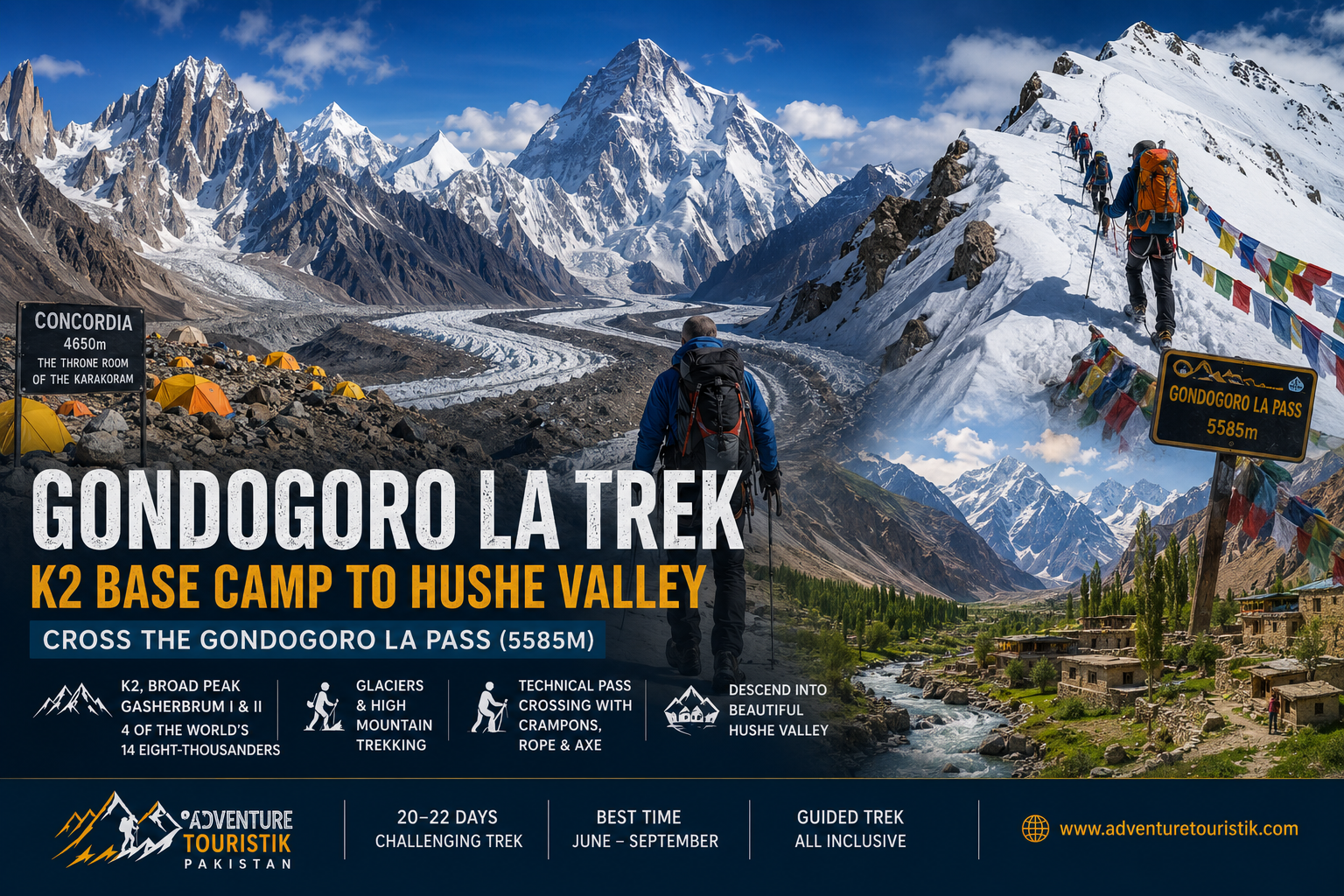
Deep in the Karakoram, this extraordinary route begins by following the legendary trail toward K2. It passes through Baltistan’s remote valleys, crosses the immense Baltoro Glacier, reaches Concordia and K2 Base Camp, and then continues beyond the standard return route toward the high Gondogoro La Pass.
Crossing the pass transforms the journey into a remarkable mountain traverse. Instead of retracing the same trail back toward Askole, trekkers descend through a completely different landscape toward Hushe Valley.
For experienced trekkers looking beyond an ordinary hiking holiday, few adventures combine glaciers, enormous mountains, wilderness, physical challenge and Balti culture quite like this one.
This guide by Adventure Touristik explains what makes the Gondogoro La journey so special, what the route actually feels like, how difficult the pass is, and what you should know before planning the trek between 2026 and 2030.
What Is the Gondogoro La Trek?
The Gondogoro La Trek is a high-altitude trekking route through the Central Karakoram region of Gilgit-Baltistan, Pakistan.
Much of its first section follows the famous approach toward K2:
Skardu → Askole → Baltoro Glacier → Concordia → K2 Base Camp
But the crucial difference comes after visiting the K2 region.
Most standard K2 Base Camp itineraries eventually return along the Baltoro Glacier. On the Gondogoro route, trekkers instead continue toward Ali Camp and attempt to cross the high Gondogoro La, descending on the opposite side toward Khuspang and eventually Hushe.
The overall journey therefore becomes something closer to a Karakoram traverse than a simple out-and-back trek.
That distinction matters.
Every few days, the character of the landscape changes. You begin among settlements and river valleys, move into increasingly barren mountain terrain, walk for days among glaciers and granite towers, reach the extraordinary amphitheater of Concordia, approach K2, cross a high snow-covered pass and finally descend toward greener valleys and human settlements again.
It feels like travelling through several different worlds on foot.
Why Gondogoro La Is Different from the Standard K2 Base Camp Trek
Both journeys share some of the greatest scenery in the Karakoram.
Trekkers on either route can experience the Baltoro Glacier, Trango Towers, Urdukas, Concordia and the K2 region.
The difference is what happens afterward.
The standard K2 Base Camp route normally involves returning through terrain you have already crossed.
The Gondogoro La route attempts something more ambitious.
It continues across the mountains.
From the upper Baltoro region, the trail heads toward Ali Camp before crossing Gondogoro La and descending toward Hushe Valley.
This creates a much greater sense of progression.
You are not simply walking somewhere and returning.
You are crossing the Karakoram.
That is also why the Gondogoro option should not be chosen simply because it sounds more adventurous. The pass introduces substantially greater physical and technical demands than the standard K2 Base Camp trek.
For the right trekker, however, it can be an extraordinary experience.
The Journey Begins in Islamabad
For most international visitors, the adventure begins far from the glaciers.
It begins in Islamabad.
The capital provides time to meet the expedition team, recover from international travel and complete final preparations before travelling north.
Then comes one of the most memorable possible introductions to the mountains of Pakistan: the flight toward Skardu.
When weather conditions cooperate, the aircraft crosses some of the most dramatic mountain geography on Earth.
The transition is remarkable.
Islamabad's broad urban landscape gradually disappears, replaced by deep valleys, enormous ridges and snow-covered summits.
Eventually, the aircraft descends toward Skardu, the gateway to many of Pakistan's greatest trekking and mountaineering expeditions.
Skardu: The Gateway to the Karakoram
Skardu is more than a logistical stop.
For trekkers, it is the final major town before entering the mountains.
Expedition teams use their time here for equipment checks, food preparation, permits, porter arrangements and last-minute supplies.
It is also worth exploring.
The wider Skardu region contains lakes, historical sites, dramatic viewpoints and a landscape shaped by the Indus River.
But there is always a particular atmosphere before a major Karakoram trek.
Duffel bags are being weighed.
Equipment is checked repeatedly.
Porter loads are organized.
Weather forecasts become increasingly interesting.
And somewhere beyond the mountains lies K2.
The Road to Askole
Leaving Skardu marks the real transition into expedition life.
The journey passes through Shigar and follows increasingly remote mountain roads toward the Braldu Valley.
Eventually you reach the Askole region, traditionally associated with the beginning of some of the world's most famous Karakoram expeditions.
For generations, mountaineers heading toward K2, Broad Peak and the Gasherbrums have passed through this landscape.
Askole represents a boundary.
Behind you are roads, hotels and towns.
Ahead are camps, glaciers and weeks in the mountains.
Walking Toward the Baltoro Glacier
The early trekking days gradually introduce the scale of the Karakoram.
The trail follows the Braldu region through an enormous dry mountain landscape where rivers cut through rock and distant peaks begin appearing above the valley walls.
Camps such as Jhola and Paiju provide important stages before reaching the Baltoro Glacier.
Paiju is particularly significant.
Many itineraries include an acclimatization or rest day here before moving onto the glacier.
The pause is useful not only physically.
It gives trekkers time to understand what lies ahead.
From this point onward, the mountains become increasingly dominant.
Stepping onto the Baltoro Glacier
Walking onto the Baltoro is one of the defining moments of the journey.
At first, people unfamiliar with large glaciers sometimes expect a smooth white river of ice.
The reality can be very different.
Large sections of the glacier are covered with rock and moraine. The walking surface rises and falls constantly, with stones shifting beneath your boots.
Movement requires concentration.
But the rewards begin immediately.
The deeper you travel, the more extraordinary the skyline becomes.
Granite towers rise directly above the glacier.
Massive walls appear around bends.
Peaks that once existed only in photographs suddenly dominate the horizon.
This is when the Gondogoro La journey begins to feel like a true expedition.
Trango Towers: Entering a World of Giants
Among the most recognizable landmarks are the Trango Towers.
These enormous granite formations rise dramatically above the Baltoro region and are internationally famous among climbers.
Seeing them from the trekking route gives a powerful sense of scale.
Photographs rarely communicate how vertical these mountains actually appear.
As you continue toward camps such as Khoburtse and Urdukas, the scenery becomes increasingly spectacular.
For many trekkers, Urdukas is particularly memorable because it provides a different perspective over the glacier.
Standing above the Baltoro and looking across an immense landscape of rock, ice and mountains can be one of the quieter highlights of the entire journey.
Deeper into the Karakoram
Beyond Urdukas, the trek moves farther into the high mountains.
The landscape becomes increasingly glaciated.
Vegetation almost disappears.
The outside world begins to feel very distant.
Masherbrum and numerous other peaks dominate sections of the route as the expedition approaches Goro and then Concordia.
By now, daily life has developed its own rhythm.
Wake up.
Pack the sleeping bag.
Eat breakfast.
Prepare your daypack.
Walk.
Drink.
Rest.
Walk again.
Reach camp.
Tea.
Dinner.
Sleep.
Repeat.
This simplicity is one of the unexpected pleasures of long mountain expeditions.
Life becomes reduced to movement, food, weather, mountains and the people travelling beside you.
Concordia: The Heart of the Karakoram
Then comes Concordia.
Few places in the mountain world have such a legendary reputation.
Located near the meeting point of major glaciers, Concordia sits within an extraordinary concentration of some of the highest and most dramatic mountains on Earth.
On a clear day, the surrounding panorama can include:
-
K2 – 8,611 m
-
Broad Peak – 8,051 m
-
Gasherbrum I – 8,080 m
-
Gasherbrum II – 8,035 m
-
numerous 7,000-metre peaks and lesser-known Karakoram giants
K2 naturally dominates attention.
But Concordia is not simply about one mountain.
The entire horizon feels monumental.
You are standing inside a landscape built on a scale that is difficult to comprehend until you experience it personally.
Walking Toward K2 Base Camp
For many trekkers, reaching the K2 region is the emotional centerpiece of the expedition.
The route continues along the Godwin-Austen Glacier toward Broad Peak Base Camp and K2 Base Camp.
Progress at altitude can feel slower.
The terrain demands attention.
The air is thinner.
But K2 grows larger.
Unlike mountains that gradually disappear behind surrounding ridges as you approach them, K2 can seem increasingly imposing.
Its steep geometry is unmistakable.
Standing near the mountain after days of walking through the Karakoram produces a very different feeling from simply seeing K2 in photographs.
You have travelled there slowly.
Every kilometer has been earned on foot.
That journey gives the destination meaning.
Yet for Gondogoro La trekkers, K2 is not the end.
Another major challenge still lies ahead.
From Concordia Toward Ali Camp
After exploring the K2 region, the route turns toward the upper Baltoro and Vigne Glacier area.
The atmosphere changes again.
Traffic becomes more limited.
The route feels increasingly committed.
Ali Camp is an important staging point before the Gondogoro La crossing.
By this stage, guides closely evaluate conditions.
Weather matters.
Snow conditions matter.
The strength and acclimatization of the group matter.
Conditions on the pass can change, and the final decision must always prioritize safety rather than itinerary expectations.
That is an important reality of serious mountain travel.
A printed itinerary cannot control the Karakoram.
Crossing Gondogoro La
The Gondogoro La crossing is the defining challenge of the trek.
It should not be treated like an ordinary hiking pass.
Depending on current conditions, the crossing may involve snow, ice, steep terrain, fixed ropes and the use of mountaineering equipment such as:
crampons, harness, helmet, ice axe and carabiners.
Teams often begin extremely early.
Moving before sunrise can provide more favorable snow conditions and allow sufficient time for the long crossing and descent.
Headlamps illuminate the route.
Boots crunch into frozen snow.
Climbers move carefully under the direction of experienced guides and high-altitude support staff.
At this point, fitness alone is not enough.
You need patience.
You need concentration.
And you need to listen carefully to your mountain team.
The View from Gondogoro La
If conditions are clear, reaching the high point can reveal one of the greatest mountain panoramas in Pakistan.
The exact visibility depends entirely on weather, but the wider Gondogoro region is celebrated for extraordinary views toward the Karakoram giants, including:
K2, Broad Peak, Gasherbrum I and Gasherbrum II.
Four of the world's fourteen 8,000-metre mountains exist within this remarkable high-mountain landscape.
But the summit is only part of the crossing.
Descending safely is equally important.
Steep sections require careful movement and strict attention to guide instructions.
Eventually, the terrain begins leading toward Khuspang.
Looking back toward the pass, there is often a powerful realization:
You have crossed from one side of the Karakoram to another.
Descending Toward Hushe Valley
After days dominated by rock, ice and snow, the descent feels almost surreal.
Gradually, the landscape softens.
Vegetation returns.
Streams flow through alpine terrain.
The air becomes richer as altitude decreases.
Camps around the Gondogoro and Hushe side provide a completely different atmosphere from Concordia and the upper glaciers.
Eventually, trekkers reach Saicho and continue toward Hushe.
The appearance of trees, fields and permanent settlement after so long among glaciers can feel surprisingly emotional.
Ordinary things become remarkable again.
A house.
Fresh vegetation.
Running water.
Children walking through a village.
A proper road.
The journey through Hushe provides a cultural conclusion to what began as a high-altitude expedition.
Is Gondogoro La a Technical Trek?
This question deserves a careful answer.
The Gondogoro La Trek is often described as semi-technical, but terminology should never create false confidence.
The journey is considerably more demanding than a conventional trekking holiday.
Depending on snow and ice conditions, participants may need to use:
-
crampons
-
harnesses
-
helmets
-
ice axes
-
carabiners
-
fixed ropes
-
roped glacier travel techniques
Trekkers may encounter steep snow slopes, glacier travel, crevasses and exposed terrain.
Conditions vary significantly from season to season and even week to week.
For this reason, the trek should be undertaken with experienced local mountain professionals who understand current conditions.
The ability to reach K2 Base Camp does not automatically mean someone is prepared to cross Gondogoro La.
How Difficult Is the Gondogoro La Trek?
A useful description is:
Challenging to very challenging, with semi-technical high-altitude sections.
Several factors contribute to the difficulty.
The expedition lasts roughly three weeks depending on the itinerary. Participants spend many consecutive days trekking. Much of the route crosses rough moraine and glacier terrain.
Then there is altitude.
The journey reaches elevations above 5,000 metres, and the pass itself is around 5,585 metres, depending on mapping and measurement references.
The crossing may also involve a very long summit day.
Successful preparation therefore requires more than being generally active.
You need strong cardiovascular endurance, leg strength, balance, recovery capacity and the mental ability to continue performing after many consecutive trekking days.
Who Should Consider This Trek?
The Gondogoro La route is best suited to people who already understand what multi-day mountain trekking feels like.
Previous experience at altitude is highly valuable.
Ideally, participants should have completed demanding multi-day treks and have some familiarity with snow or mountain environments.
Basic experience using crampons and a harness is beneficial.
Most importantly, trekkers must be comfortable following guide instructions.
This is not a place for ego.
If conditions require turning around or changing the itinerary, the mountains make the decision.
Best Time for the Gondogoro La Trek
The main trekking season generally falls during the Karakoram summer, broadly between June and September.
However, choosing a Gondogoro La departure is more complicated than simply selecting the warmest month.
Snow conditions on the pass, glacier conditions, temperatures, weather patterns and seasonal route management all matter.
July and August are among the most popular periods for major Karakoram trekking expeditions.
Earlier or later departures can present different conditions.
There is no month that guarantees perfect weather.
Even during summer, high-altitude Karakoram conditions can change rapidly.
Snowfall, strong wind, cloud and significant temperature changes remain possible.
Travelers planning a Gondogoro La Trek in 2026, 2027, 2028, 2029 or 2030 should therefore choose departure dates based on current operational advice rather than generic internet weather averages alone.
Acclimatization Is Part of the Journey
Good itineraries should not rush the mountains.
The route naturally gains altitude over several days, and dedicated acclimatization time can help participants adapt before reaching the highest sections.
Even so, altitude affects everyone differently.
Being extremely fit does not make someone immune to altitude illness.
Trekkers should understand common warning signs and communicate symptoms honestly with their guide.
Trying to hide headaches, nausea or unusual weakness because you do not want to slow down the group is a poor strategy.
Good expedition culture depends on communication.
The goal is not simply to cross the pass.
The goal is to complete the journey safely.
A Typical 20–22 Day Gondogoro La Trek Itinerary
Exact itineraries vary according to road access, flights, weather and mountain conditions, but a well-paced journey generally follows this progression:
Day 1: Arrival in Islamabad and expedition briefing
Day 2: Flight to Skardu, weather permitting
Day 3: Skardu preparation and sightseeing
Day 4: Drive toward Askole/Jhola region depending on road access
Day 5: Trek toward Paiju
Day 6: Acclimatization at Paiju
Day 7: Trek onto the Baltoro Glacier toward Khoburtse
Day 8: Trek to Urdukas
Day 9: Trek toward Goro
Day 10: Reach Concordia
Day 11: Explore toward Broad Peak Base Camp
Day 12: K2 Base Camp excursion and return toward Concordia
Day 13: Trek toward Ali Camp
Day 14: Cross Gondogoro La and descend toward Khuspang
Day 15: Contingency/rest day depending on conditions
Day 16: Descend toward Saicho
Day 17: Trek to Hushe and drive toward Skardu
Day 18: Return toward Islamabad, normally by flight if operating
Day 19: Contingency or Islamabad day
Day 20: International departure
Some programs extend the trip to 21 or 22 days to provide additional flexibility.
This is often sensible.
In the Karakoram, contingency days are not wasted days.
They are part of responsible expedition planning.
What Is a Typical Trekking Day Like?
Camp mornings usually begin early.
The support team prepares breakfast while trekkers organize personal equipment and pack their duffel bags.
Your main luggage is generally transported according to the expedition's porter arrangements, while you carry a daypack containing the things you need while walking.
That normally includes water, extra clothing, sun protection, snacks, camera equipment and essential personal items.
Walking time varies significantly.
Some days may involve five or six hours.
Others can be considerably longer, particularly when terrain, altitude or major crossings are involved.
Upon reaching camp, trekkers usually receive tea or refreshments before settling into tents.
Dinner is served in the mess tent.
Then the temperature drops.
And people go to sleep surprisingly early.
Food on the Trek
Eating properly is essential on a long expedition.
Meals typically combine Pakistani dishes with familiar trekking foods.
Breakfast might include eggs, porridge, bread or chapati, tea and coffee.
Lunches are often designed to be practical during trekking days.
Dinner is usually the main cooked meal and may include rice, pasta, lentils, vegetables, soups, meat dishes and local-style meals depending on supplies.
As the expedition progresses deeper into the mountains, fresh ingredients naturally become more limited.
Good cooks are among the unsung heroes of Karakoram expeditions.
Producing warm, varied meals for a trekking group in such remote conditions requires remarkable skill.
Water and Hydration
Hydration becomes especially important at altitude.
Water sources vary throughout the journey and may include streams and glacial meltwater.
Trekking teams normally follow appropriate treatment, boiling or purification procedures according to the location and operating system.
Trekkers should carry suitable reusable bottles or hydration containers and follow the guide's advice regarding safe drinking water.
Do not underestimate how much dehydration can affect performance at altitude.
Cold weather often reduces the desire to drink even when your body needs more fluid.
What Should You Pack?
The correct equipment can significantly affect your experience.
Essential categories generally include:
Trekking equipment: well-broken-in boots, trekking poles, daypack, duffel bag and gaiters where appropriate.
Cold-weather clothing: thermal base layers, insulating mid-layers, quality down jacket, waterproof shell, trekking trousers, gloves and warm headwear.
Camping equipment: an appropriately rated sleeping bag and personal sleeping accessories according to the operator's equipment arrangements.
Sun protection: high-SPF sunscreen, glacier-capable sunglasses, sun hat and lip protection.
Technical equipment: depending on what is supplied or rented, crampons, harness, helmet, ice axe and suitable carabiners may be required for Gondogoro La.
Never assume technical equipment is automatically included.
Confirm exactly what is provided before arriving in Pakistan.
Training for Gondogoro La
Training should begin months before departure, not several days before your flight.
A strong program should combine cardiovascular endurance with mountain-specific strength.
Long uphill walks with a loaded daypack are among the best forms of preparation.
Stair climbing, hiking, cycling and sustained cardiovascular exercise can help develop endurance.
Strength work should focus particularly on legs, glutes and core stability.
But there is another element people often overlook:
back-to-back training days.
Being able to hike strongly for one day is not enough.
On the Gondogoro La route, you need to wake up the next morning and do it again.
And again.
Training your body to recover between consecutive long days is extremely valuable.
Internal Flights and Weather Delays
Flights between Islamabad and Skardu can be spectacular, but mountain aviation is weather dependent.
Cancellations and delays are possible.
A responsible itinerary therefore includes contingency planning.
If flights cannot operate, overland travel may become necessary depending on road and security conditions at the time.
International travelers should avoid booking extremely tight connections immediately after returning from the mountains.
Building flexibility into your schedule can prevent unnecessary stress.
Camping and Accommodation
Most Gondogoro La expeditions combine hotels in cities with full-service camping during the trek.
In Islamabad and Skardu, accommodation is normally in hotels.
Once trekking begins, tents become home.
A supported expedition typically includes sleeping tents and shared expedition infrastructure such as dining, kitchen and toilet facilities, though exact standards vary by package.
After many nights in the mountains, returning to a hotel in Skardu can feel extraordinarily luxurious.
A hot shower suddenly becomes one of life's greatest inventions.
Guides, Porters and the People Behind the Expedition
No serious discussion of trekking in the Karakoram should ignore the people who make these journeys possible.
Guides, cooks, porters, high-altitude staff and drivers form the backbone of every successful expedition.
Porters carry supplies through terrain that many visitors find difficult even with a light daypack.
Cooks somehow prepare meals in isolated camps.
Guides make continuous decisions involving route conditions, weather, altitude and group safety.
When choosing an operator, travelers should look beyond price.
Responsible staff treatment, appropriate insurance, fair working practices, suitable equipment and experienced leadership matter enormously.
A cheap expedition achieved by cutting corners in these areas is not a bargain.
Permits and Trekking Regulations
The K2, Baltoro and Central Karakoram region involves regulated trekking areas, and foreign visitors may require permits, registrations and other formalities depending on the route and current government rules.
Requirements and fees can change.
This is one reason booking through a properly registered Pakistani tour operator is important.
Your operator should explain which permits and government charges are included and which are payable separately.
Always confirm current requirements before departure rather than relying on an old blog or social media post.
Travel Insurance for Gondogoro La
Standard holiday insurance may not be sufficient.
Travelers should obtain a policy appropriate for the actual altitude and activities involved.
Check the fine print.
The policy should be suitable for high-altitude trekking at the elevations reached on your itinerary and should address emergency medical treatment and evacuation according to your needs.
Do not assume that a policy advertised as "adventure travel insurance" automatically covers a 5,500-metre semi-technical mountain pass.
Ask the insurer directly.
Why You Need Flexibility in the Karakoram
One of the most important things to bring is something that weighs nothing:
patience.
Road conditions can change.
Flights can be delayed.
Weather can stop movement.
Snow conditions can affect Gondogoro La.
A campsite may need to change.
The safest plan may not always match the printed itinerary.
Travelers who arrive expecting every hour to operate like a city tour often struggle with expedition travel.
The Karakoram rewards flexibility.
Sometimes the unexpected day becomes the story you remember most.
Gondogoro La Trek vs K2 Base Camp Trek
Choosing between these two adventures depends on your experience and objectives.
If your main dream is to see K2, experience Concordia and walk the Baltoro Glacier without undertaking the additional technical challenge of a high pass, the classic K2 Base Camp Trek may be the better choice.
If you already have strong trekking experience and want a more demanding traverse, the Gondogoro route offers something different.
Its great advantage is the circuit.
You experience the classic Baltoro and K2 landscapes but leave through another side of the mountains.
That makes the journey feel remarkably complete.
Can Solo Travelers Join?
Yes, solo travelers commonly join scheduled group departures operated by trekking companies.
This can be one of the best ways to experience the route.
Expedition groups quickly develop their own small community.
You eat together.
Walk together.
Deal with difficult weather together.
Celebrate milestones together.
By the time you reach Hushe, people who met as strangers in Islamabad often feel like an expedition family.
Private departures can also be organized for friends, clubs and custom groups.
Responsible Trekking in the Karakoram
The beauty of the Karakoram comes with responsibility.
Remote mountain environments recover slowly from damage.
Trekkers should minimize single-use waste, follow established waste-management systems, avoid leaving litter and respect campsite regulations.
Cultural respect is equally important.
Communities in Baltistan and Hushe Valley are not simply attractions along a trekking route.
They are living communities with their own traditions, languages and values.
Ask permission before taking close photographs of people.
Dress respectfully when visiting villages.
Support local businesses where appropriate.
Travel should leave something positive behind.
Why Trek with a Local Pakistani Operator?
Local expertise matters enormously in the Karakoram.
A Pakistan-based operator works directly within the environment where the expedition takes place.
Local teams understand mountain logistics, regional culture, porter networks, transportation challenges and the practical realities of operating in Baltistan.
For travelers planning the Gondogoro La Trek Pakistan 2026–2030, Adventure Touristik can arrange guided trekking programs, private departures and customized Pakistan itineraries.
The objective should not simply be to sell a place on a departure.
It should be to match travelers with the right adventure.
For some people, that will be Gondogoro La.
For others, K2 Base Camp without the pass will be a wiser choice.
Good expedition planning starts with knowing the difference.
Frequently Asked Questions
How long is the Gondogoro La Trek?
A complete international itinerary generally takes around 20–22 days, depending on the route design, acclimatization schedule and contingency days. The actual trekking portion is shorter than the complete Islamabad-to-Islamabad program.
What is the altitude of Gondogoro La?
Gondogoro La is commonly listed at approximately 5,585 metres, although published figures vary slightly between sources and mapping references.
Can beginners do the Gondogoro La Trek?
It is not recommended as a first serious mountain trek. Previous multi-day trekking and high-altitude experience are strongly advisable.
Do I need climbing experience?
Full technical mountaineering experience may not always be required for guided crossings under suitable conditions, but familiarity with crampons, harnesses and snow travel is highly beneficial. Current conditions ultimately determine the technical demands.
Is Gondogoro La harder than K2 Base Camp?
Yes. Both are demanding expeditions, but Gondogoro La adds a high, potentially technical pass crossing involving snow, glacier terrain and fixed-rope sections.
What is the best time to trek?
The principal season is generally June to September, with July and August among the most common months. Actual pass conditions should always be confirmed with local operators.
Can I see K2 from Gondogoro La?
In clear conditions, the Gondogoro La region can provide spectacular views toward K2 and other major Karakoram peaks. Visibility is never guaranteed because mountain weather changes quickly.
Which 8,000-metre peaks can be seen in the region?
The wider route offers views toward four eight-thousanders: K2, Broad Peak, Gasherbrum I and Gasherbrum II, depending on location and weather.
Is travel insurance necessary?
Strongly recommended. Your policy should specifically cover the altitude and activities included in your itinerary and provide appropriate emergency provisions.
How can I book a Gondogoro La Trek in Pakistan?
You can contact Adventure Touristik for scheduled or customized Gondogoro La and K2 trekking programs for 2026–2030.
A Journey That Goes Beyond K2
It would be easy to describe Gondogoro La using numbers.
K2: 8,611 metres.
Gondogoro La: approximately 5,585 metres.
Four 8,000-metre peaks.
Weeks in the Karakoram.
Days walking across glaciers.
But those numbers do not explain why people remember this journey for the rest of their lives.
The memories are usually more personal.
The first glimpse of the Trango Towers.
Morning light over the Baltoro.
Tea after a long trekking day.
Seeing K2 rise above Concordia.
Walking by headlamp toward Gondogoro La.
The silence at altitude.
The relief of reaching the other side.
And finally, after spending so long surrounded by ice and stone, seeing the green landscape of Hushe Valley appear below.
The K2 and Gondogoro La Trek is not simply about reaching a base camp or standing on a mountain pass.
It is about travelling through the Karakoram from one world into another.
For trekkers who arrive prepared, respect the mountains and accept the uncertainty that comes with a genuine expedition, it can become one of the defining adventures of a lifetime.
Plan your Gondogoro La Trek Pakistan 2026–2030 with Adventure Touristik — guided by local expertise from Pakistan.
WhatsApp: +92 355 5808382